In an effort to reduce gang-based violence and murder in one of Cape Town’s most gang-affected communities, the CeaseFire Hanover Park project was launched in late 2012. Using Dimagi’s CommCare platform, the Safety Lab has developed a system for CeaseFire to more efficiently and effectively capture data on evolving trends in gang violence in the area, so that the program can better predict, and try to prevent, violence. The system has also freed up field workers to focus on violence intervention and prevention work on the streets, rather than expending countless hours culling through paper-based logistical work in the office.
CeaseFire Hanover Park
CeaseFire Hanover Park is a gang-violence intervention and prevention program based in a community in Cape Town, South Africa, that is plagued by high levels of gang-related violence. In 2012 and 2013, the year that the program was launched, the police precinct in which Hanover Park is situated recorded 71 murders for an area with 53,911 people, 34,625 of whom live in Hanover Park.
The CeaseFire program seeks to reduce gang-related violence through the training and deployment of field workers who act as outreach workers and “violence interrupters.” Most of the field workers are reformed ex-gang members who have been trained to mediate conflicts between gangs on the streets before these conflicts turn violent.
Why trend data matters
The detection and interruption of planned violence by gang members is a key component of the CeaseFire program, which relies on accurate and up-to-date trend data. An area that might experience a sudden increase in threats of violence is more likely to see a future increase in attempted murders; an area with a spike in attempted murders is more likely to see a rise in actual murders. To prevent this escalation, the CeaseFire program increases the number of field workers in an identified risk area to help mitigate conflict and thereby reduce the likelihood of a gang-related murder from occurring.
The problem with paper
Previously, this data collection was done using paper forms that required outreach workers to fill in paperwork on a daily, case-by-case basis, from a remote office. Once the data collection forms were completed and filed, they then had to be recorded on a spreadsheet and plotted on a map. Only then did this allow for trends to be spotted and acted upon. It is a system that works at maximum impact only if data is recorded accurately, consistently, and promptly.
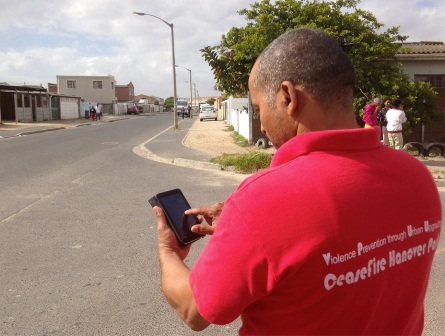
The street is an inopportune place to do paperwork: carrying a clipboard can compromise the field workers’ mediation work by undermining the trust they have with members of the community. As a result, the paper-based data collection system demanded that field workers spend a significant amount of time in the office. However, in an environment that can experience periodic episodes of very high violence, increasing the need for field workers to be on the streets actively preventing violence rather than doing administrative work, this is far from ideal.
Prior to the introduction of the CommCare system, CeaseFire Hanover Park was having significant problems with the violence-prediction system, including:
- Data capturing: completed paper forms that needed to be captured were piling up due to an on-the-ground reality that prioritized active presence in the street over administrative work during times of high violence.
- Data integrity: field workers submitting their forms late, often many days after an event had occurred, thereby creating a lag in the system and reducing the accuracy of the data. The greater this gap between observation of an event and recording or submission of the related data, the less fresh it was in their mind, thereby compromising accuracy. Additionally, field workers were often loath to fill in paper-based forms after a long day spent mitigating conflicts on the street.
How CommCare helps
In order to help streamline CeaseFire’s data collection and capture operations, a CommCare app was developed featuring the five forms that are most commonly used by the field workers to record violence-prevention interventions, threats of violence, high-risk individuals, and the time and location of shootings.
The paper forms tend to be long, and their extensive use of text to convey meaning is not as effective as the combination of text and simple symbols afforded by the CommCare tool. To help streamline the process of completing the forms, encourage outreach workers to fill them in, and reduce the room for error, simple icons were developed and deployed for each question. Once a field worker is acquainted with the forms and the symbols for each question, the process of filling in the forms is greatly expedited. The app was deployed on Android devices to allow for a simple user interface that resonates with the field workers’ comfort using their own mobile phones. The CommCare app has helped to:
- Streamline and enhance the efficiency of the data-capture process.
- Incentivize field workers to relay information on the street shortly after an event has occurred.
- Increase the ease of filling in the forms and the accuracy of information captured.
- Increase the likelihood that a field worker will fill in a form immediately after an event has occurred.
- Enable access to data on the real-time situation on the street, and make it immediately accessible.
About the author: Douglas is a researcher at The Safety Lab, an innovation hub and test center based in the Western Cape province of South Africa that aims to catalyze social innovation to develop effective, innovative, street-ready safety solutions.
See what CommCare can do for your program
Talk with our team about digitizing service delivery and monitoring for your frontline workforce.
Get in touch