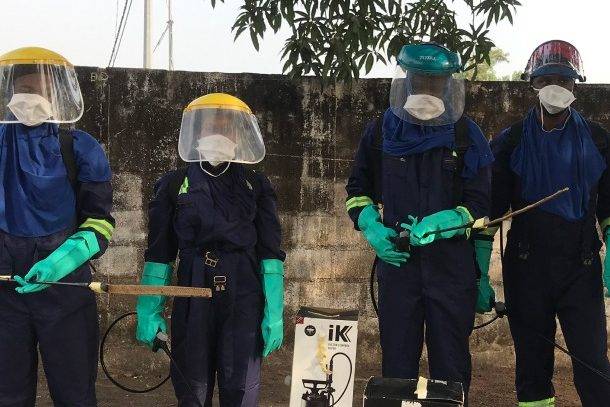
The Malaria Initiative Africa Indoor Residual Spraying (PMI AIRS) program is dedicated to reducing malaria in Africa through an innovative, community-driven approach that includes Indoor Residual Spraying (IRS). IRS involves spraying insecticide on the walls, ceilings, and other common indoor resting places of mosquitoes. In 2014, Dimagi joined the United States President’s Malaria Initiative (PMI) and Abt Associates to provide an mHealth solution for sustainable intervention, building it on CommCare. The tools and systems provide efficient access to daily spray activity indicators and improve supervisory efforts, and the project has resulted in preventing millions from contracting malaria throughout the African continent.
The problem
Nearly half of the world’s population was at risk of the vector-borne disease malaria in 2019. Yet Africa accounts for over 90% of the approximately 400,000 deaths that are caused by malaria each year, and an estimated 229 million people fall sick from malaria.
The African region carries a disproportionately high percentage of global malaria cases, and those most at risk of developing severe symptoms are infants, children under five, pregnant women, and patients with HIV/AIDS. In 2019, children under five accounted for approximately 67% of all deaths caused by malaria. The World Health Organization (WHO) has recommended indoor residual spraying and insecticide-treated mosquito nets as the two most effective forms of vector control.
While IRS is proven to reduce and prevent malaria, the spray campaigns face various challenges. Teams made up of spray operators and supervisors often go into rural, sometimes hard-to-reach areas in order to spray the interior of homes and structures. Some of the challenges faced include working in remote places with limited connectivity, tight implementation windows, large seasonal teams, limited group training opportunities, and data that requires immediate follow-up action.
The solution
As per the WHO’s recommendation, combining IRS with the distribution of mosquito nets is proven to be the most effective prevention of malaria to date. Between 2000 and 2015, Abt Associates estimated that PMI AIRS helped to reduce malaria incidence in Africa by 42% and reduce the mortality rate by 66%, including an approximated 71% decline in mortality in children under five. However, for this method to be effective, enough structures need to be sprayed in a given area. This is one of the reasons that monitoring the spray progress of each operation site is vital to the project.
To combat the challenges that teams face on the ground, Dimagi developed and deployed an mHealth solution to ensure the success of spray campaigns. Spray teams are able to submit their spray progress each day by highlighting the number of sprayers, the number of structures found, the number of structures sprayed, and the number of insecticide units used. This provides supervisors with a high-level overview of the progress of the spray campaign.
Another important part of the daily report supervisors receive is the summary of compliance issues or red flags. The application has checklists to ensure compliance with safety protocols and environmental and health guidelines. When there is a compliance issue, the app acts as a job aid by advising what to do and who is responsible for taking that action, and supervisors are then able to react with immediate effect.
Spraying is only viable during a certain window before the malaria season begins, so the mHealth solution provides efficient communication and reliable data analysis for the project to be implemented effectively given the short timelines. Above this, it aims to enhance monitoring and evaluation performance, while also creating an avenue to promote gender equality and provide remote support.
App overview
Dimagi joined Abt Associates and PMI VectorLink to develop an mHealth system to support the IRS campaign, and has been supporting the project in 17 countries across Africa since 2014, responsible for the design, implementation, training, and support of the mHealth component. To meet the various demands of an IRS campaign, Dimagi built an mHealth system composed of four key components.
The CommCare supervisory application contains five checklists to ensure compliance, one data collection verification (DCV) form, and an auto-Progress Monitoring Tracker (PMT) form that automatically structures a keyword SMS to be sent to the gateway to monitor the spray progress.
The SMS system supports the progress monitoring tracker. Team leaders and storekeepers send a structured SMS every day with four key indicators:
- Number of sprayers
- Number of structures found
- Number of structures sprayed
- Number of insecticide units used
The SMS system consists of gateway devices set up on Telerivet, a messaging platform. Telerivet is integrated with CommCare, where the spray progress is then calculated in reports. Broadcast messages are sent from Telerivet on a daily basis, including reminders, advice, and compliance guidelines for the various groups implementing the project in the field.
Daily email reports are also sent to Abt staff, program staff, supervisors, and government stakeholders. These include progress updates against the spray target for each operation site, as well as any supervision concerns. The daily emails allow program staff to react immediately, especially important given that the spray campaigns require swift action at precise times during the year.
Feature highlight
One of the things that makes VectorLink unique is that there are two master applications pulling to 17 different domains that are translated into eight different languages. Each domain represents a different country, and lookup tables are used to customize each application.
Users send a structured keyword SMS to a gateway device set up on Telerivet that is integrated with CommCare. The SMS is run through a CommCare form, and if an error is identified in the form, an automated SMS is sent to the user on how to correct it. Otherwise, it saves the message to the PMT case. Spray targets are set for each operation site in a lookup table, and the PMT case data is then compared to the target to pull the percentage of spray coverage in a report. The auto-PMT form is used in CommCare to structure the SMS and mitigate the number of erroneous submissions.
Given the tight implementation windows and the number of structures sprayed being crucial to the success of any spray campaign, conditional alerts have been set up. Each operation site is meant to send a PMT SMS report for each day of the spray campaign. If it does not, an automated SMS is sent out to the spray operator’s supervisor for attention. This ensures the percentage of spray coverage is accurate and that VectorLink staff can assess any need for intervention.
Implementation
Each year, Dimagi manages and supports the implementation of the mHealth component of the PMI AIRS program in an average of 15 countries per year since joining in 2014. This involves maintenance of the two applications that are now pulled to a total of 17 country domains (as of 2021). Once the template app is finalized, each country application has to be customized and configured. This also involves user management, which can range anywhere from 30 users to more than 250 users. There were approximately 1,931 users configured in CommCare in 2020 alone.
When a new country joins the program, Dimagi usually travels to the country to provide comprehensive training, set up the system, and support the new team. However, COVID-19 changed things drastically for the team in 2020. Three new countries that joined PMI AIRS had to be trained and set up remotely. There is also recurring training for each spray campaign, including training on the CommCare application, PMT system, Telerivet, and how to analyze the data using CommCare reports. Training materials and sessions have been conducted in three different languages: English, French, and Portuguese. Dimagi provides the master training to the VectorLink team, who then train the spray operators, team leaders, brigade supervisors, storekeepers, district coordinators, and monitoring and evaluation assistants.
Dimagi also advises the VectorLink team in-country on device procurement and management. Once the team is ready for deployment, Dimagi provides support on troubleshooting and analyzes the daily reports for any signs of intervention required. Weekly meetings are scheduled with the VectorLink mHealth focal point until the campaign comes to an end. Dimagi and Abt Associates revise the applications at the end of each year to find innovative solutions to improve the system and ensure the success of the program.
“Dimagi has played a tremendous role in supporting our efforts in data analysis. This has helped the team make informed decisions based on facts and not simply their intuition. With communication being a key factor to success, Dimagi has exhibited impressive levels of responsiveness. For any issues raised or inquiries made, Dimagi replied in less than a day.”
Evaline Ajwang, Monitoring & Evaluation Coordinator for VectorLink Uganda
Impact
There have been wide-reaching reductions in morbidity and mortality from malaria mostly due to PMI AIRS interventions. While Dimagi is one of 11 program partners to execute this multi-country approach to eradicate malaria, the impacts of the program overall have been far-reaching. In 2020 alone, with the additional challenges of COVID-19, an estimated 21.3 million people were protected from malaria, which included 3.49 million children and 636,527 women. (These figures include the 26 countries PMI AIRS is conducted in, while Dimagi currently operates in 17 of those countries.)
In 2020 alone, an estimated 21.3 million people were protected from malaria across the PMI AIRS program, including 3.49 million children and 636,527 women.
Stakeholders and VectorLink staff have reported enhanced communication and visibility so that they can understand what is happening in the field in real time during IRS campaigns. Three daily reports and a weekly report are sent to the team to allow them to make strategic decisions and intervene when necessary. The availability of data has allowed the team to get a holistic view of the campaign and improved decision-making that is time sensitive.
“Dimagi continues to be our main partner in the coordination, development, and maintenance of mHealth activities within the PMI VectorLink Project. The CommCare application has contributed to the improvement in speed of availability of vector control data and has enhanced IRS field supervision. This partnership has ensured that evidence-based decision-making and strategic planning are translated into effective implementation on the ground.”
Albert Acquaye, Senior Associate at Abt Associates
Coordinating a multi-country campaign?
Talk to our team about running large, time-sensitive field campaigns on CommCare.
Get in touch