
In this post
Data is the fuel that powers a digital health system. It lets a Ministry of Health report on indicators, lets funders assess their impact, and lets technology teams deliver what stakeholders need. But data is powerless if it is not accurate and up to date.
The digital health data pipeline
A well built data pipeline is how you get accurate, fresh data: it captures trusted community-level information and aggregates it for both routine reporting and one-off analysis.
Teams around the world pair the two to build these pipelines. CommCare combines frontline decision support with routine data capture, so service delivery improves and the data gets more accurate at the same time. The CommCare platform then feeds that community-level data straight into DHIS2 for a Ministry of Health’s reports.
How CommCare and DHIS2 work together
Each platform plays a critical but different role. CommCare handles mobile data collection and aggregation. DHIS2 stores the aggregated data and reports on key indicators.
Mobile data collection
Your collection tool has to feed the pipeline with trusted information and stay reliable at any scale, from a few field teams to thousands of community health workers capturing data offline. CommCare does both, in two ways the alternatives do not.
More trusted data
Because service delivery and data capture happen in one workflow, community health workers record information in real time, as they deliver care. Other tools separate the two, asking workers with limited literacy to enter complex health information straight into a database, often after the fact from paper notes. That produces far more errors and a less reliable flow of information.
Greater reliability at every scale
CommCare is the world’s most widely adopted solution for offline mobile data collection, and every part of it, from the mobile application through the DHIS2 integration, is tested and supported by Dimagi’s engineers. As of 2019, more than 2,000 programs had deployed CommCare in over 80 countries, and 60 independent studies had confirmed its impact on digital health systems. You can browse that research base in full.
| Area | CommCare mobile |
|---|---|
| Data quality | One application supports every frontline workflow, so data is captured accurately and in real time. Mobile case management then aggregates raw survey data with tracked entities and health indicators automatically, with no manual effort. |
| Administration | Administrators build and maintain their own data collection apps through a self-service web portal, without writing code, and can monitor how community health workers use the application and inspect the data coming in from the field. |
| Reliability | More than 2,000 projects run on CommCare, from single communities to nationwide health systems. Dimagi tests every release, and enterprise-grade data and user management features protect the system end to end. |
Aggregating your data
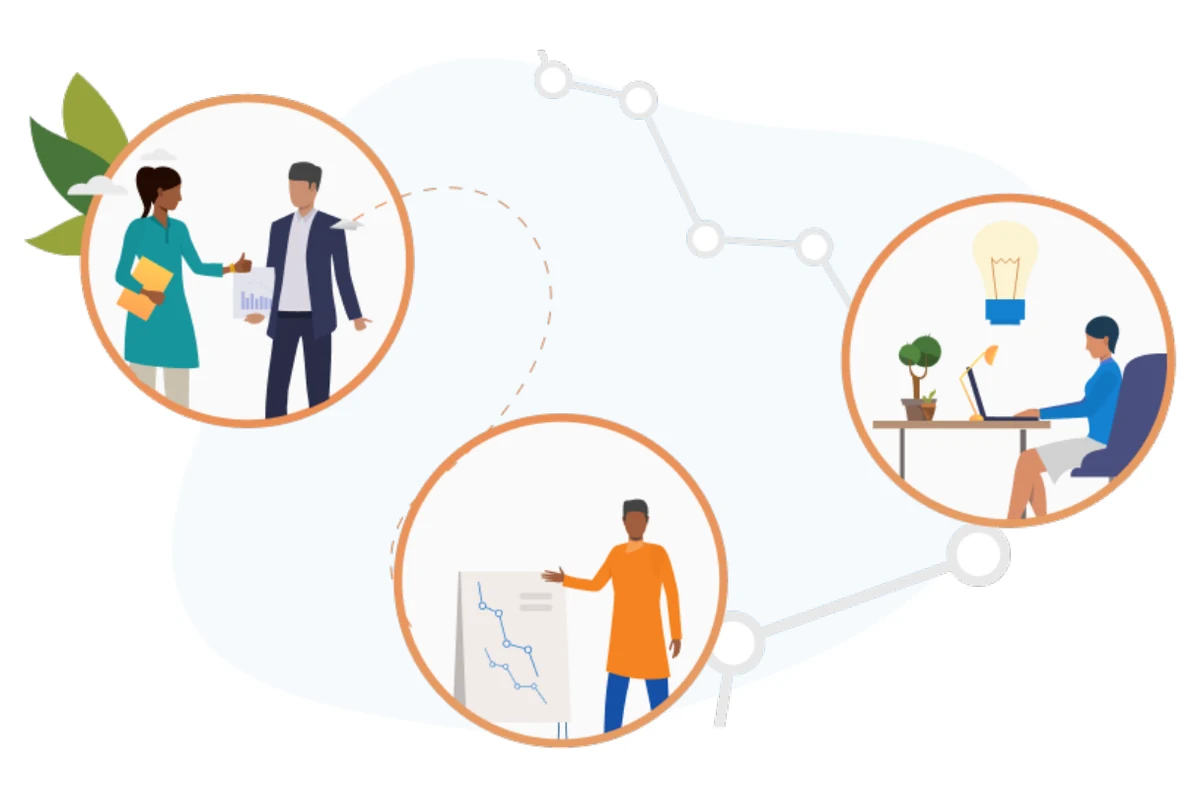
Raw data has to be aggregated before a reporting tool like DHIS2 can use it, and CommCare automates that step. Ministry of Health teams in Mozambique, Madagascar, Malawi, and Burkina Faso already rely on these workflows, which run in three parts:
- Capture. Community health workers record data while delivering frontline services.
- Transform. Automated workflows turn that raw data into aggregated fields that line up with top-level health indicators.
- Send. CommCare pushes the aggregated data to DHIS2 for storage and reporting.
Integrating the two platforms
You need to be confident in the integration underneath your pipeline. Dimagi’s Solutions team is an in-house technology consultancy that builds those connections with you:
Integration engineers
Engineers who have delivered dozens of digital health integrations and will build yours against your system’s specific requirements.
Program managers
Managers who work with technical and non-technical stakeholders alike to deliver on time and to your standards.
The team works two ways. As an end-to-end service, covering scoping, execution, and quality assurance, integrations typically take three months or less. As a technical advisory service, Dimagi advises while your own team builds, on a timeline that suits your program.
Evaluating the sustainability of a CommCare and DHIS2 system
When you deliver a digital health solution for government stakeholders, you need an accurate picture of what it costs and what it returns. That means a holistic cost-benefit analysis of the options in front of you.

That analysis has two parts. Hard costs are the sticker price of the software. For open source platforms like CommCare and DHIS2 they are a small portion of your technology budget, driven by hardware if you host locally or subscription fees if you host in the cloud. Soft costs are the indirect costs of deployment, and they will account for the majority: the staffing to set up, maintain, and support the solution, plus training and the effort of cleaning and auditing data.
Hard costs: hosting your platform
Both CommCare and DHIS2 offer free, open source solutions to mobile data collection that can be hosted locally.
One size rarely fits all, though. You need options for the cases where a stakeholder’s technology capacity, operating budget, or data governance requirements do not line up with hosting everything locally. CommCare runs across a range of deployments, from full local ownership through cloud hosting to fully managed software as a service.
| Local hosting | Hybrid | Virtual private cloud | Public cloud | Fully hosted service | |
|---|---|---|---|---|---|
| Where is it hosted? | Your local server | Data available locally, the rest of the infrastructure in a secure cloud | Your choice of virtual private cloud provider | Your choice of public cloud provider | Dimagi’s secure cloud infrastructure |
| What are the costs? | You pay for hardware procurement | Monthly subscription fees | You pay cloud server fees | You pay cloud server fees | Monthly subscription fees |
| Who configures it? | Your choice: Dimagi or your own technology team | You access data locally, Dimagi manages the cloud services | Your choice: Dimagi or your own technology team | Your choice: Dimagi or your own technology team | Dimagi fully manages the service |
Soft costs: the true cost of ownership
Deployment is only one part of the equation. In practice, soft costs have an outsized effect on long-term sustainability, so weigh the investment required against the returns your stakeholders will see.
At startup
You invest the effort to design, build, and deploy the mobile application and train frontline teams. You get an immediate improvement in data quality and freshness.
At operation and scale
You invest in maintaining applications, supporting community health workers, and auditing data. You get less time cleaning data and a Ministry of Health that can actually use community-level data for reporting.
Each product produces very different startup costs and downstream effects. Here is how those soft costs play out with CommCare.
| Area | CommCare mobile |
|---|---|
| Setup and maintenance | The self-service web portal minimizes the time, and therefore the cost, your team spends building and testing apps, and lets administrators push updates to field teams quickly. Dimagi’s support team and extensive documentation lower setup costs further. |
| Training and support | The mobile application is purpose-built for users with limited literacy, so teams need very little training before they collect accurate data. One study found a 75% reduction in training time with CommCare. |
| Data quality | Case management and decision support are built into the capture workflow, so teams record data during service delivery and your pipeline fills in real time. |
| Platform reliability | A rigorously tested backend means your stakeholders will not spend budget troubleshooting software problems, or need to re-engage Dimagi or a third party to support operations and scale-up. |
Putting it all together
For teams adding community-level data to a DHIS2-based system, CommCare is the most proven and cost-effective option for everyone involved, from technology administrators to Ministry of Health teams and funders.
The evidence base keeps growing. In Madagascar, 550 community health worker data collectors feed a CommCare to DHIS2 pipeline. In Burkina Faso, 1,800 health centers, 6,000 community health worker users, and 2.5 million beneficiaries run on a national-scale system built on the two platforms.
Planning a CommCare and DHIS2 integration?
Tell us about your program and we will walk through what a sustainable data pipeline would look like for your team.
Get in touch