How Investments in Frontline Digital Tools Now Can Prepare Us for the Next Pandemic
Dimagi, Medic, and The Rockefeller Foundation explore how investing in digital tools for frontline workers today can prepare us for the next pandemic.
Published by Dimagi, Medic & The Rockefeller FoundationDate Jul 2021Reading time ~12 min
Overview
COVID-19 swept the world like no other pandemic in the last century, as of July 2021 it has infected well over 175 million people, killing millions, and shutting down economies. Pandemics like this were predicted by many experts, and more pandemics are likely to arise again. It is well worth investment now to be prepared for future pandemics in order to avert future loss of life and economic impacts, which could well be even worse than those of COVID-19.
In particular, the COVID-19 pandemic highlights the critical role of digital technology, frontline workers, and rapid response in mitigating the toll of such public health emergencies. The goal of this report is to explore how investments in digital platforms for frontline workers (FLWs), such as the Community Health Toolkit (CHT) and CommCare, can help better prepare for future pandemics.
The recommendations in this report are organized into three strategies. The first strategy is to invest in early detection of future infectious threats so that we can contain or avert them before they become pandemics -- or respond more quickly to contain and mitigate them. The second strategy is to invest now in our ability to respond more efficiently to future pandemics by building digital solutions which are ready to be immediately deployed, as well as to maintain and improve capacity for using digital technology in pandemic response. The third strategy is to become better prepared for future pandemics by investing in system strengthening initiatives that create immediate value and will allow health systems to more effectively deal with future pandemics.
Authors
Isaac Holeman — Medic (isaac@medicmobile.org)
Jordan Lerner — Dimagi (jlerner@dimagi.com)
Neal Lesh — Dimagi (nlesh@dimagi.com)
Helen Olsen — Medic (isaac@medicmobile.org)
Leo Wolansky — The Rockefeller Foundation (lwolansky@rockfound.org)
Strategy #1
Early Detection and Containment
COVID-19 was initially reported to the WHO on December 31, 2019. On January 30, 2020, the WHO declared the COVID-19 outbreak a global health emergency and later declared it a global pandemic on March 11, the first such designation since H1N1 in 2009.
One important area to invest in is the early detection of disease outbreaks, which can prevent a viral threat from becoming a global pandemic. Even if a pandemic cannot be averted, earlier detection can lead to a quicker response that can save lives. One learning from COVID-19 was that every day mattered, and it was hugely advantageous to launch technology-supported response efforts as soon as possible.
Analyzing Existing Data Sources
Historically most disease surveillance systems have been relatively disconnected from the information systems used to support frontline workers as they provide routine care. This is a missed opportunity, because digital technologies that support routine care are already generating tremendous amounts of data that can be employed to detect outbreaks faster. Through platforms such as CommCare and CHT, frontline workers routinely collect relevant data for disease outbreak, such as symptoms of their clients (e.g., fever or coughing) as part of their standard service delivery.
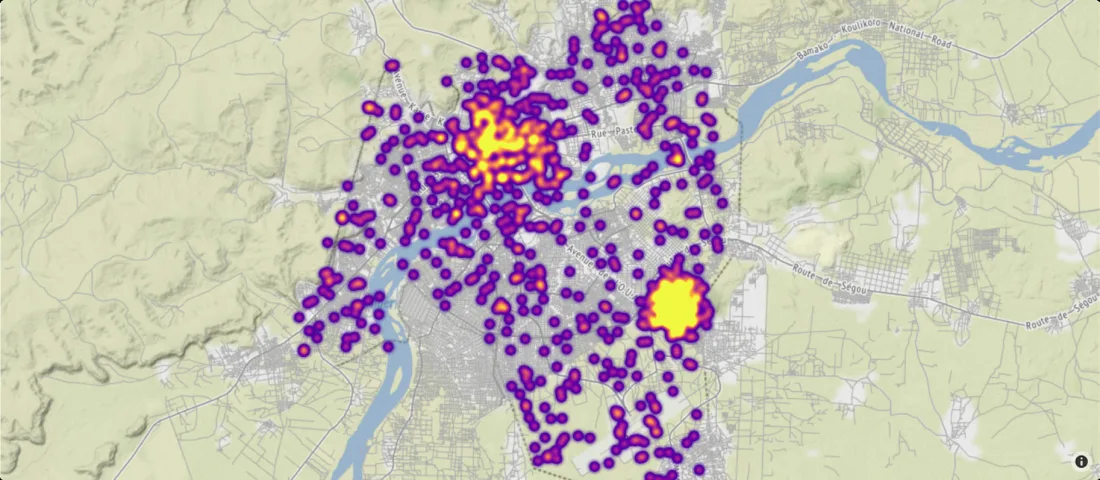
As shown in Figure 1, data visualization of FLW-collected data can be used to focus investigation and follow up on possible outbreaks. Additionally, anomaly detection methods can be run on these data to identify potential illness clusters, and response protocols can be invoked when they exceed certain thresholds. Establishing and sustaining such a system requires efforts to ensure that data are sufficiently comprehensive, consistent, reliable, and relevant; algorithms for detecting the signal in the data; the design of interfaces that present algorithm outputs in a way that triggers action; the ability to investigate potential clusters; and the ability to initiate useful responses when clusters are confirmed across scales of health systems.
While much of this can be achieved without technical innovation there is substantial effort required to establish such a system, and incentivize organizations that use digital solutions to participate in it.
Figure 1: The interactive map is shown here is a simulation of how surveillance data can be visualized. Each point represents a suspected, tested, or confirmed case. Areas of high density (the yellow clusters in the map) warrant further investigation..
Generating New Data Sources
In addition to better leveraging existing data sets, there is tremendous potential in deploying systems that will generate new sources of data that will be useful for pandemic detection. For example, led by the Broad Institute and ACEGID, Dimagi received funding in 2020 from the Audacious Project to launch Sentinel, a platform for detecting viral threats. Sentinel involves leveraging ultra-sensitive genomic and CRISPR technologies to detect pathogens, e.g, through the use of new diagnostic platforms that can test for hundreds of known viruses simultaneously from blood or other samples. Scaling up such diagnostic platforms, as well as the digital solutions that empower public health communities to use them, could dramatically streamline the work of detecting future pandemics.
Dimagi and Medic have also collaborated on relevant work with the CloudWorks platform, which provides a standard way for digital solutions to incorporate electronic readers of physical diagnostics, such as Rapid Diagnostic Tests (RDTs) for malaria. CloudWorks will also support the integration of new electronic diagnostics that are entirely digital. For example, there has been preliminary success at using machine learning to detect pneumonia and tuberculosis from a person’s cough, asphyxia from a child’s cry, malnutrition and heart rate from short videos, and diabetes from pictures of people’s eyes. By standardizing and simplifying how electronic readers and electronic diagnostics can be added to existing digital solutions, CloudWorks aims to help spread and scale these technologies.
The data collected by CloudWorks is also especially well suited to outbreak detection. For example, a rise in negative malaria tests could indicate a rise in unexplained fevers. Investments in CloudWorks or novel electronic diagnostics could thus help detect future pandemics by increasing the amount of data available for outbreak detection.
Strategy #2
Fast and Effective Response
Consolidating Gains Made From Supporting COVID-19
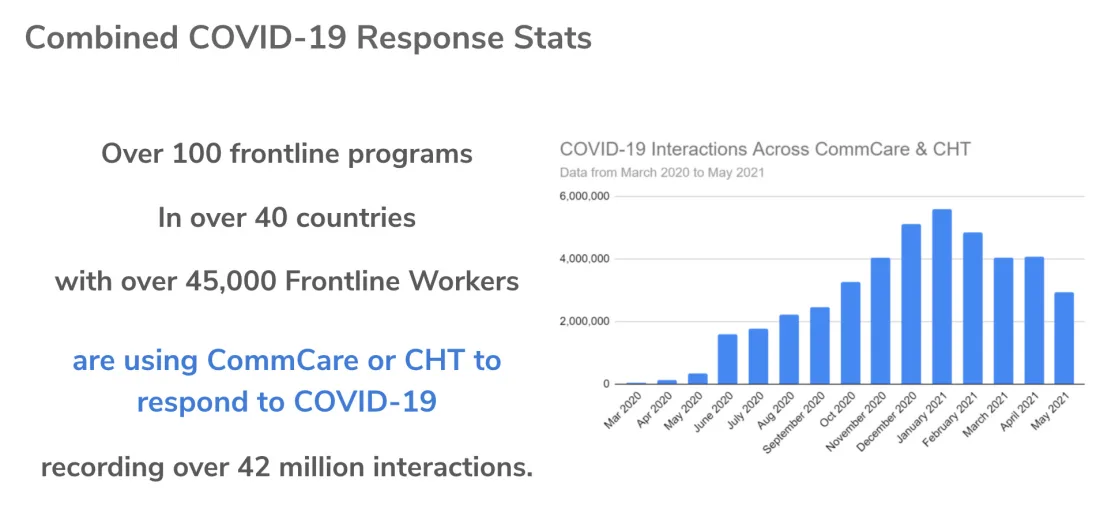
In the context of the pandemic, organizations like Dimagi and Medic made significant strides in developing digital support for methods of communicable disease control such as contact tracing and event-based surveillance. As shown in Figure 2, there was considerable uptake of the solutions developed on our platforms. We were not starting from scratch but rather building off of past efforts including our experience with Ebola outbreaks in West Africa, as well as routine surveillance operations around the world. In the last year our teams have learned a great deal more about pandemic response and developed a range of solutions for COVID-19; these efforts leave us in a better position to address future pandemics, even without further planning.
That said, there is considerable room for further investment to consolidate our work for COVID-19, and to create a more comprehensive set of digital apps to support communicable disease control efforts. This would include some relatively unglamorous work such as refactoring code bases and creating improved documentation to build these apps to generate an improved suite of apps for future use.
In addition, there is space for continued reflection and improved methodologies for rapid roll out and adaptation of template or reference apps. One of the common findings across the field of digital development was that template or reference COVID-19 response apps were rarely deployed as-is, but instead required substantial adaptation. The templates provided a strong framework and enabled organizations and governments to move quickly but prior to launch customization was required in order to meet local protocol and include all relevant indicators. We can rebuild our apps with this in mind. For example, we can design them to be as modular as possible so that implementers can pick and choose what makes sense for their program and can more easily adapt them to their unique needs. We can also develop training and documentation to help others learn how to make their own adaptations in the context of global health emergencies and shifting care protocols.
Figure 2: Statistics on uptake of solutions developed by Medic and Dimagi for COVID-19 response.
Capacity for Pandemic Response
Reflecting on COVID-19 response, there are several problems that we can see repeating themselves in future pandemics:
Decision Making for Choosing and Deploying Digital Solutions
There were some common pain points that slowed government rollout of COVID-19 response activities and digital platforms to support them. Governments were besieged by offers of help from various software organizations - these offers, while well intentioned, came from actors across varying levels of experience and expertise. In the context of a novel virus it was challenging to discern the benefits of one offer of support from another and committees were convened to sort through the proposals over extended periods of time to make (or not make) decisions.
Capacity within Digital Development Organizations
Both Medic and Dimagi are proud of how quickly we mobilized to help address COVID-19. Our efforts started in mid-February and we were in full swing by mid-March. In hindsight, there was room for improvement however. We might have started to invest more as soon as COVID-19 was on the horizon, even in hopes that it would not have been needed. At this moment, there is a good deal of institutional knowledge in both Dimagi and Medic that would be relevant for the role of digital solutions in supporting the response to future pandemics. However, this knowledge may degrade over time. It would be valuable for digital development organizations to be incentivized to maintain the capacity, through conferences or other dissemination activities.
Donor Readiness
There is room for improvement in how quickly donors can react to crises. We would recommend funds be made available to be quickly distributed to many prominent organizations that support global digital goods at the onset of future pandemics. This pandemic has very clearly demonstrated the need for digital solutions to support almost all pandemic response activities, and so it is hard to imagine that digital global goods would not play an important role in all future pandemics. As an example, Dimagi received funding from Johnson and Johnson Foundation and McGovern in the early weeks of our efforts to address COVID-19 which enabled our team to launch contact tracing solutions in places as varied as San Francisco to Togo all by the end of March 2020.
We propose to address these problems through a combination of advocacy, education, and convenings. These efforts could focus on developing a shared set of principles (such as the well-known Principles of Digital Development). One important principle would be to use proven platforms, in particular global digital goods, during pandemic response. These platforms and the organizations that support them have a track record of working in LMICs; the practical experience and relationships that come with such track records should not be underestimated. Equally important, investments in these platforms during crises is much more likely to convert into longer term health system strengthening. This could be aided by funders and governments to create policies to use the WHO’s Digital Health Atlas to ensure that people can more easily understand the footprints of these tools. This would involve both more effort to populate the Digital Health Atlas, as well as improvements and demonstrations for how it can be used to inform decision making.
A second principle we would propose is to accommodate commercial cloud hosting infrastructure during crisis response. During COVID-19, many response efforts were delayed by countries requesting that on-premise servers be set up rather than using cloud servers. These conversations addressed a range of important issues such as data privacy and sovereignty, the data controlling or ownership role of governments, and compliance with local data regulations. Yet policy makers would invariably arrive at the conclusion that, in the context of a pressing public health emergency, existing cloud infrastructure was the most reliable and expedient approach. There are also examples from COVID-19 of countries that typically use in-country servers going quickly to the cloud under these emergency circumstances. It is worth effort before the next pandemic to streamline some of this decision making.
Finally, there could be great benefit from annual convenings including government stakeholders and digital development organizations. This could be organized as a tabletop simulation or data drills, in which the players react to a fictional crisis over the course of a few days. It could also involve the building of apps by digital development organizations as part of the simulation.
Digital Solutions for Equitable Vaccine Delivery
One success story in COVID-19 response was the remarkably fast development and approval of safe and extremely effective COVID-19 vaccines. We expect that rapidly developed vaccines will play a large role in future pandemics.
A key area for investment to prepare for future pandemics is to lay the groundwork to help distribute new vaccines equitably and efficiently. As of the writing of this document, there is substantial effort underway to provide such digital solutions for LMICs in COVID-19. Important groundwork for these efforts was laid by Dimagi, Medic, and Ona coming together to coordinate key terms and recommended practices for how digital tools can support different phases of vaccine delivery, as outlined in this presentation.
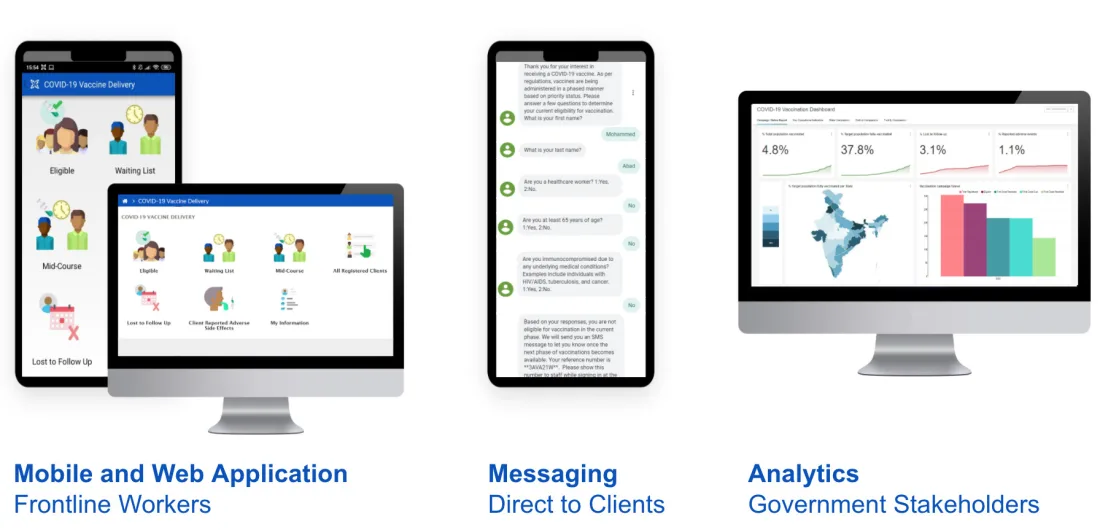
Dimagi’s solution (Figure 3) is being deployed in several countries, including Somalia, Burkina Faso, Guatemala, and Jamaica. This solution enables the tracking and support of vaccine recipients before, during and after they are vaccinated while providing analytics and visualizations to monitor the progress of vaccine delivery. The system supports vaccine administrators ability to screen potential recipients for eligibility, and track delivery over time. It supports direct messaging to clients for dose confirmation and self reporting and adverse events. It includes solutions, co-designed with Medic, for community health workers to coordinate and follow up on recipients that are lost to follow up, and dashboards for tracking the progression and efficacy of the campaign.
There is an urgent need for investment in 2021 to support the roll out of these solutions in LMICs for the COVID-19 vaccine. There may well be an ongoing need for years to come for administering COVID-19 vaccine booster shots at large scale. Looking beyond COVID-19, there will be a need to learn from the COVID-19 vaccine rollout and develop digital solutions for rapid, widescale, emergency roll out of vaccines in LMICs to combat pandemics. Ideally this investment will go towards supporting routine immunization with capabilities to quickly deploy new vaccines to entire populations as needed.
Figure 3: The vaccine delivery solution tracks each client from when they first register to get the vaccine, their first dose, second dose, and afterwards.Strategy #3
Preparing for Pandemics Through System Strengthening
Applying the Pandemic Platform to Other Diseases
It’s hard to motivate investment in digital solutions that will not be immediately used. And, given the rapid pace of advances in technology, it might not be wise to do so. One approach would be to invest in activities that are highly aligned with the needs of pandemic preparedness.
A promising candidate would be to build comprehensive digital solutions to support large-scale efforts for eradication of malaria in targeted geographies. In addition to the direct benefits of this work, we would also be keeping our “knives sharp” in the event of future pandemics. With this goal in mind, we would not have to compromise efforts to develop extensive systems for case finding, treatment, supervision of mitigation techniques, etc. needed to fully eradicate a disease. These efforts could also serve as testbeds and training grounds for pandemic response activities, including enhancing the ability of health systems to diagnose, treat, and routinely monitor patients in communities at the last mile.
In addition to supporting the eradication of malaria, there are multiple opportunities to test pandemic-developed platforms by applying them to neglected tropical diseases (NTDs). For example, another candidate would be to launch a large-scale effort to suppress Lassa fever in West Africa, which each year has a seasonal outbreak that infects 100,000 to 300,000 per year. Such an effort would be well positioned to detect possible outbreaks, such as Ebola, and it might parallel pandemics better than malaria, though it would have a smaller immediate impact.
Routine Emergency Response Support in FLW Apps
The COVID-19 pandemic revealed that many digital solutions for FLWs are not designed for remote, rapid modification. Digital apps may be periodically updated, but there is expectation that this will happen over a period of time and will be supported with additional in-person trainings.
There are in fact many circumstances in which it would be advantageous to rapidly introduce new workflows into digital apps. Imagine there is a flood, earthquake, or some other emergency. In the current state, even if FLWs had been using digital apps for years, they would likely not expect those apps to be helpful in these emergencies.
To address this, we might more often build in rapid emergency adaptations as part of the design and training of the apps. During training, the FLWs could be told to imagine that an emergency has happened, and then have new workflows, forms, and instructions pop up on their apps. Platforms such as CHT and CommCare could be extended to more readily support this kind of rapid response which would be helpful in future pandemics, as well as more localized emergencies.
Remote Training
Another area that could warrant more investment to improve response to future pandemics is remote, digital training. During COVID-19, we learned the importance of remote training and support for frontline users.
There is a lot of room for improvement in how FLWs are currently trained on new content, where the norm is lengthy, in-person meetings. These trainings serve an essential purpose, but also are expensive, time consuming, and do not necessarily engage FLWs as well as possible to fully absorb the material. As COVID-19 showed us, during a pandemic they are also impossible despite the need to rapidly disseminate new information.
There is tremendous potential to leverage digital technology to improve training and establish the ability to do it with less or no in-person training. There is a wide range of options such as using digital to enhance in-person training, using digital to follow up on and supplement in-person training, or largely replacing in-person training with remote only solutions.
For example, we could invest now in approaches in which new lessons are downloaded to FLWs smartphones on a range of topics including health information or self-care and resilience for the FLWs themselves. These lessons could be consumed through self-paced learning, quizzes, and/or discussion groups over platforms such as Whatsapp. Establishing this capacity would enhance the ability to rapidly roll out new information and digital tools during future pandemics.
There are existing platforms and work to build upon, including efforts from UNICEF and a growing global community of organizations such as Last Mile Health. For example, Last Mile Health has worked with the Ministry of Health in Liberia on remote training, which has distributed smartphones to every community and frontline health worker in the national program. Last Mile Health provides educational content over these smartphones on malnutrition and malaria, including text, videos, and quizzes.
Shared Analytics Repository
One area that is worth highlighting is the development of digital tools that can be shared across multiple platforms. This contrasts with some of our efforts which involves sharing designs of apps that then get built in both platforms. Medic and Dimagi are now investing in more shared tools, starting with the visualizations developed under the Rockefeller Foundation grant and also including additional analytics built with funding from Google.org.
There is vast potential to invest more in this shared repository approach, as well as to build specific modules within it that would be particularly relevant for pandemic preparedness. The advantages of a shared analytics repository include:
Less duplication of effort, e.g. a digital development org can use an analytics module from the repository rather than develop one itself.
More consistency of terms, metrics, and analytics across digital platforms.
Higher quality of analytics modules vs. if each organization develops them on their own, as individual modules can be tested more widely and iterated on more often.
Greater range of analytics modules available vs. having to conceptualize them on a program by program basis.
The largest advantages stem from reducing the conceptualization, testing, refinement, and documentation stages of analytics modules. That is, it is not that hard to develop a new analytics module if you have a clear specification of it. In contrast, when you start out with a basic question or general need, it often takes extensive effort to develop an analytics module to answer that question or meet that general need.
When the next pandemic comes, it is our hope that we will be able to leverage established tools, such a shared analytics repository populated with modules that are most useful for managing the different phases of the pandemic, such as modules that help assess disruption of care based on digital data, or help health systems to better respond and support care providers.
Conclusion
Our report outlines three strategic recommendations derived from Medic and Dimagi’s collaboration and learnings over the past year as we worked together to respond to the COVID-19 pandemic. We are excited about investing in early detection for future infectious threats, improving our ability to respond rapidly to future pandemics by building digital solutions that are ready for immediate deployment, and investing in system strengthening initiatives that create immediate value and will be useful in dealing with future pandemics. These recommendations offer pathways for future investment in pandemic response platforms and the use of digital platforms to support care delivery after this pandemic and in preparation for the next.
Contact Us
Dimagi — info@dimagi.com
Medic — hello@medicmobile.org
The Rockefeller Foundation — lwolansky@rockfound.org
This report is based on work funded by The Rockefeller Foundation. The findings and conclusions contained within are those of the authors and do not necessarily reflect positions or policies of The Rockefeller Foundation.
Pandemic preparedness
Building digital tools for frontline pandemic response?