In this post
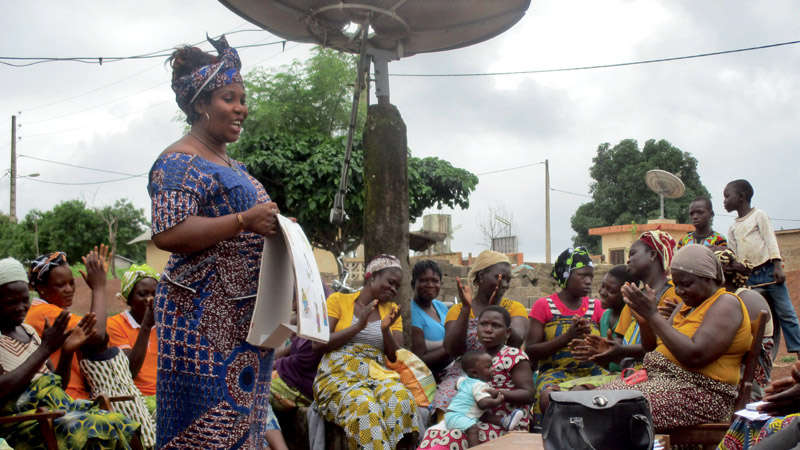
South Africa’s Ward Based Primary Healthcare Outreach Team (WBPHCOT) program supports underserved communities across all of the country’s 52 districts. Focusing on a range of areas, the program aims to improve nutrition, reproductive health and family planning, primary care for children, and social services and grants for South Africans across the country.
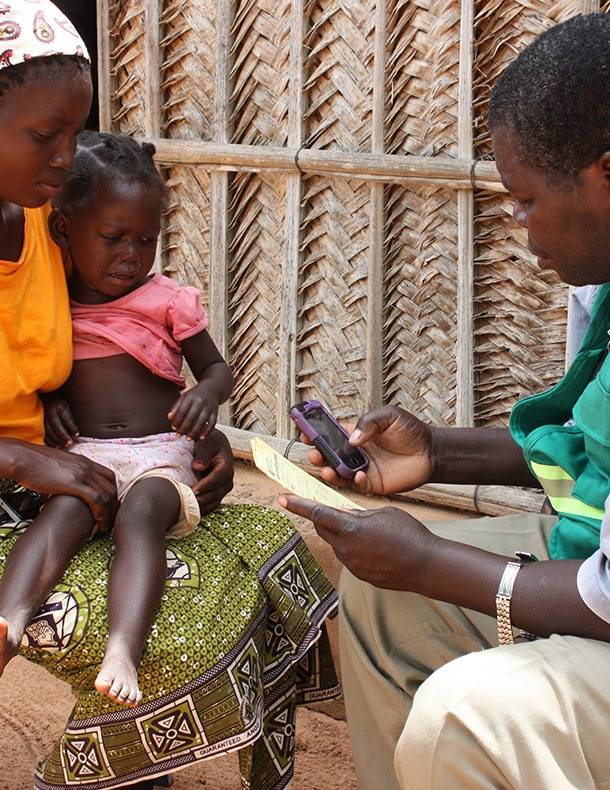
More than 60,000 community health workers have been the heart of this program for decades, but recently, the South Africa National Department of Health (NDoH) has begun efforts to centralize, digitize, and arm this powerful workforce with tools to meet their needs.
South Africa has experimented with community health worker programs since the 1940s, and WBPHCOT is one of the region’s strongest. A program of that scope carried a data problem to match. The old approach meant poor quality data, decentralized data, and a variety of inefficient legacy systems that left no way to make timely, data-driven decisions. In late 2018, Dimagi began supporting the NDoH to develop and implement a comprehensive suite of mHealth tools built on the CommCare platform.
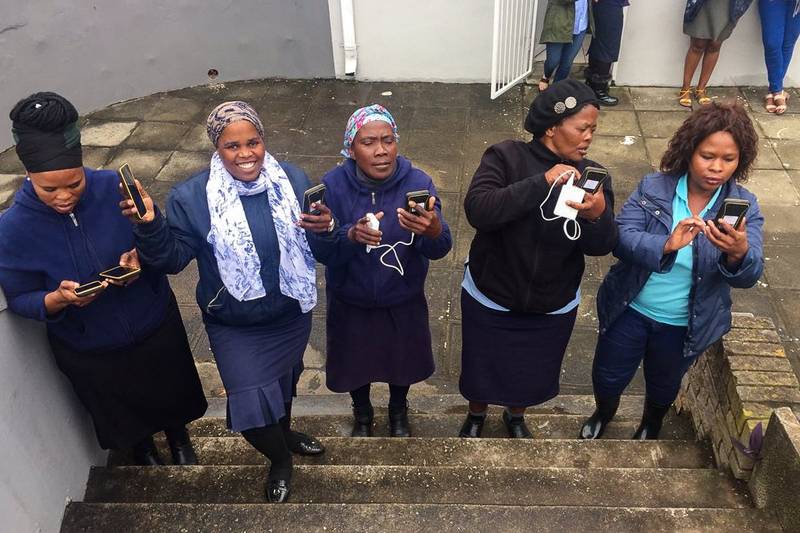
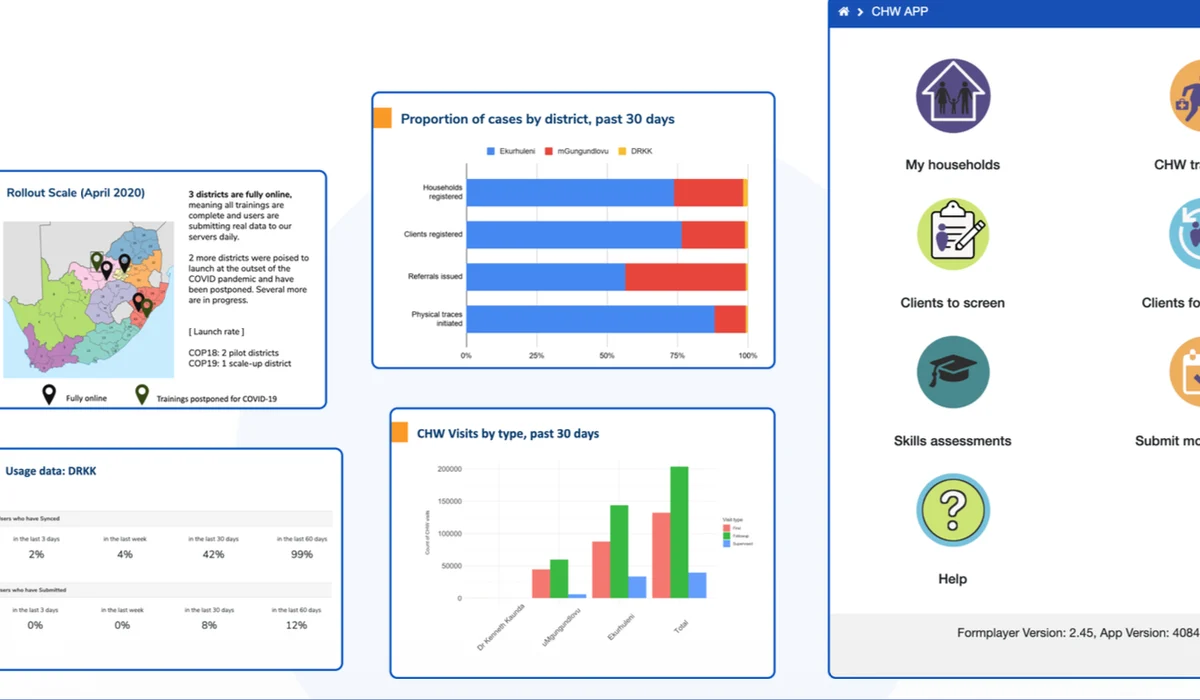
Today, the WBPHCOT program’s CommCare applications have been deployed in five districts across South Africa with more than 6,500 community health workers. These workers have registered more than 150,000 households and are providing ongoing service to nearly 500,000 clients.
More than 6,500 community health workers across five districts have registered over 150,000 households, providing ongoing service to nearly 500,000 clients.
South Africa’s twin epidemics, tuberculosis (TB) and HIV, mean that a great deal of emphasis is placed on testing, adherence support, and linkage to care for very vulnerable populations, and these community health workers manage many of their clients’ needs one-on-one for years.
What the system includes
In partnership with local implementing organizations and the NDoH, Dimagi deployed a system that encompasses the WBPHCOT workflow end to end:
- Community health worker application for protocol adherence, service linkage, and data collection.
- Supervisor application for outreach team leaders to handle team management and monthly reporting.
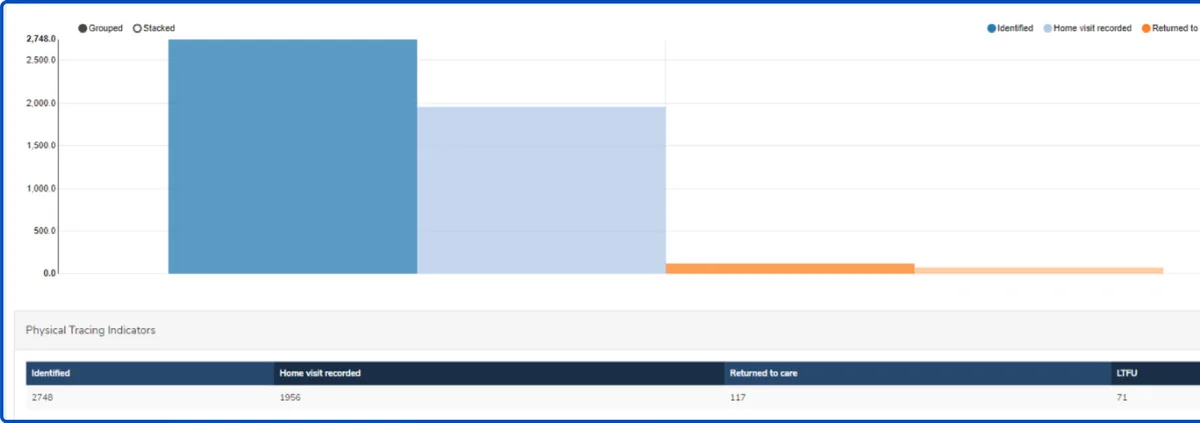
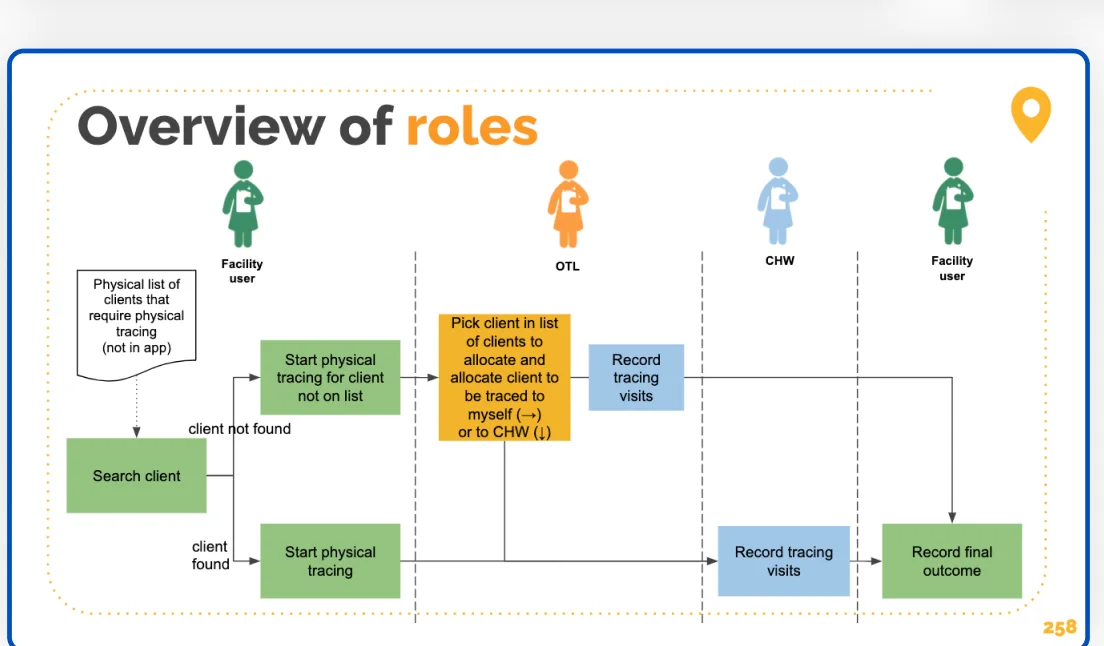
- Facility application to manage physical tracing and return to care for high-risk clients.
- Secure web platform for program coordination and data access.
- Help desk mobile app and web interface for on-demand technical support.
Five core workflows
The WBPHCOT system covers five major workflows:
- Household and client registration
- Client screening for HIV, TB, child health, COVID-19, and a variety of other areas
- Targeted follow-up for key conditions
- Referral linkage to health facilities
- Physical tracing for high-risk clients and defaulters
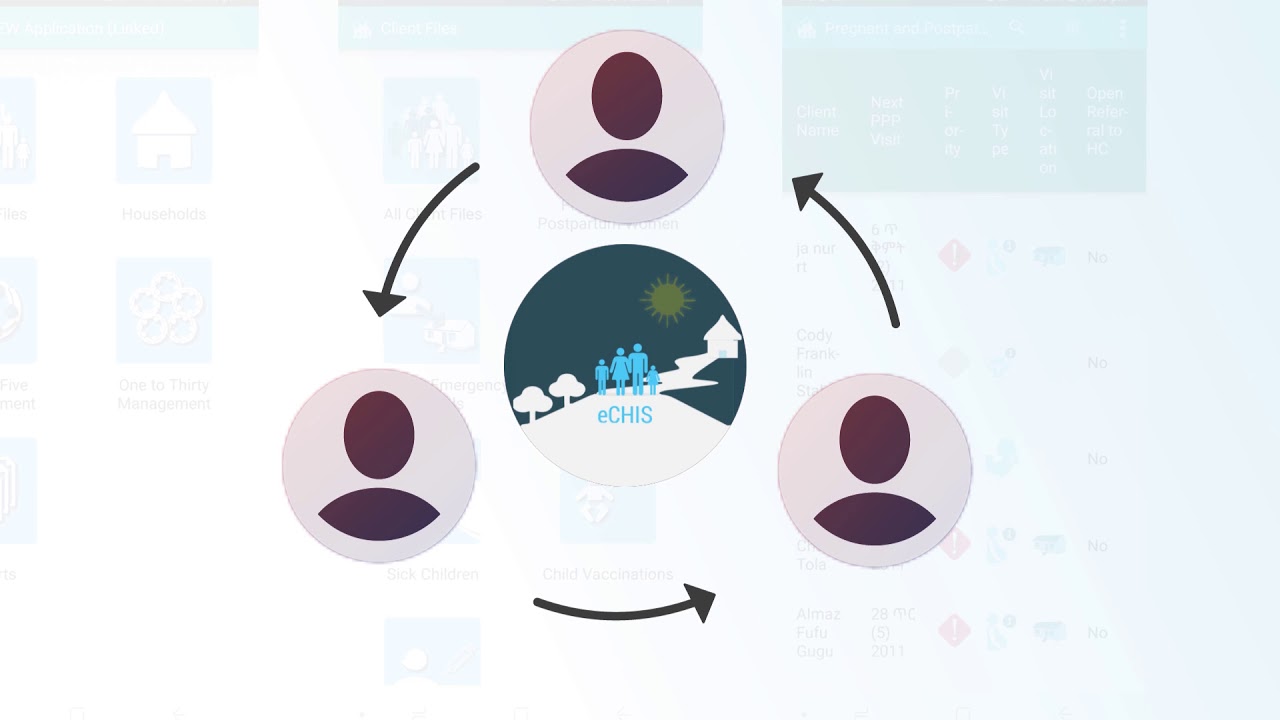
Community health workers and supervisors exchange data in real time, and built-in application logic provides dynamic alerts and reactive protocol support. Early users have praised the applications’ ease of use and intuitive nature, which we credit to our close relationship with WBPHCOT coordinators and their strong leadership during the development process.
More than a mobile application
Dimagi’s support of the WBPHCOT program involved much more than just the development of a mobile application. Our team also supplemented the NDoH’s work in a number of complementary aspects of the larger mHealth program:
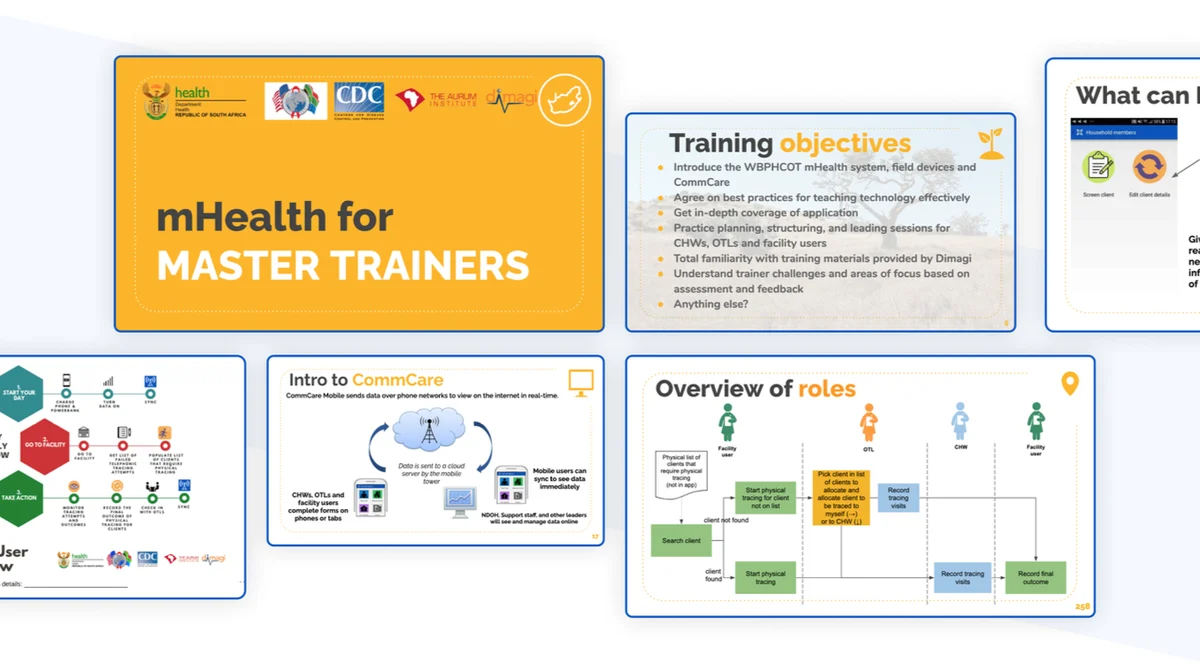
- Training program design: Dimagi worked closely with head implementing partners, including the Aurum Health Institute, to design a streamlined training program and certify a central cadre of Master Trainers. We developed a comprehensive set of digital manuals, printed content, videos, and web content for national circulation, and continue to manage updates and distribution.
- Helpdesk and implementation support: Modeled on the support desk we built for ICDS-CAS in India, which serves 600,000 mobile workers, we implemented a multi-tier tech support network on CommCare tools to provide quick resolution of hardware, software, and connectivity issues for all users. A network of Dimagi-trained mHealth Coordinators supports users directly in the field and fills data requests from stakeholders and government actors, while our team monitors usage data and shares key findings to encourage user success.
- Government engagement: From the outset, our management team worked side-by-side with other partners on liaising with key national and provincial administrators to present national-scale strategy and act as key participants in various technical working group meetings and funder interactions. Dimagi served as a technical and programmatic resource to gather requirements, present demos, and guide rollout strategy, always with an eye toward building capacity for local ownership of the program.
- Technical assistance on device selection and management: Dimagi provided rigorous device testing services, provided direct support and technical inputs to the Request for Proposal (RFP) for choosing a device vendor, and worked closely with the hardware vendor and telecommunications service provider on the installation of CommCare and on meeting the technical and quality requirements for the project.
- Reporting and data use at scale: Dimagi technology and services staff regularly collaborate with government actors and implementing partners to tailor data exports, design and build reports, and build capacity for strategic data use, including support for secure end-to-end data flow and integration with existing tools.
Reception and the road ahead
Initial reception of the WBPHCOT program’s CommCare applications has been widely positive, with users describing the tools as “user-friendly and easy to understand.” They also felt the app is “much easier and improves the way service delivery will be handled.”
Work continues on the ongoing improvement of the WBPHCOT system, and Dimagi will maintain its support of the NDoH in sustaining the system through 2020 and beyond. The eventual objective will be to cover all 27 President’s Emergency Plan for AIDS Relief (PEPFAR) districts, totaling 38,000 users, at a rate of two to three districts per month.
Bring frontline programs to scale
Talk with our team about deploying CommCare for national-scale community health programs.
Get in touch