As part of their Integrated eDiagnostic Approach, Terre des hommes partnered with Dimagi to create a tablet-based application known as the Electronic Register of Consultations (REC). Built on Dimagi’s CommCare platform, the REC aims to increase nurses’ adherence to Integrated Management of Childhood Illnesses (IMCI) protocols and improve their quality of care by providing enhanced decision support and case management capacity. More than 4,000 community health workers use the REC to treat around 200,000 children every month in 1,132 clinics across the country. The program has been so successful that it is being transitioned to Ministry of Health ownership.
The problem
According to the World Bank, the child mortality rate in Burkina Faso is more than six times higher than the United Nations’ target. Most of these deaths are preventable and due to a lack of access to operating health services, which could have provided care for a number of treatable pathologies, such as malaria, diarrhea, acute respiratory infections, measles, and acute malnutrition.
The IMCI strategy, a systematic approach to diagnosing child illness in low-resource settings, is used in more than 75 countries to address these issues. Unfortunately, fewer than 30% of clinics actually used it. The nurses in these clinics are often faced with high numbers of patients, have limited literacy, and have a limited amount of time to fill out diagnostic reports, all of which dissuade them from adhering to time-consuming, technical IMCI protocols.
The solution
The REC mobile health system is built on Dimagi’s CommCare platform and includes a tablet-based mobile application and a web dashboard. The entire system aims to improve the capacity of participating clinics to engage in robust, data-driven workforce management.
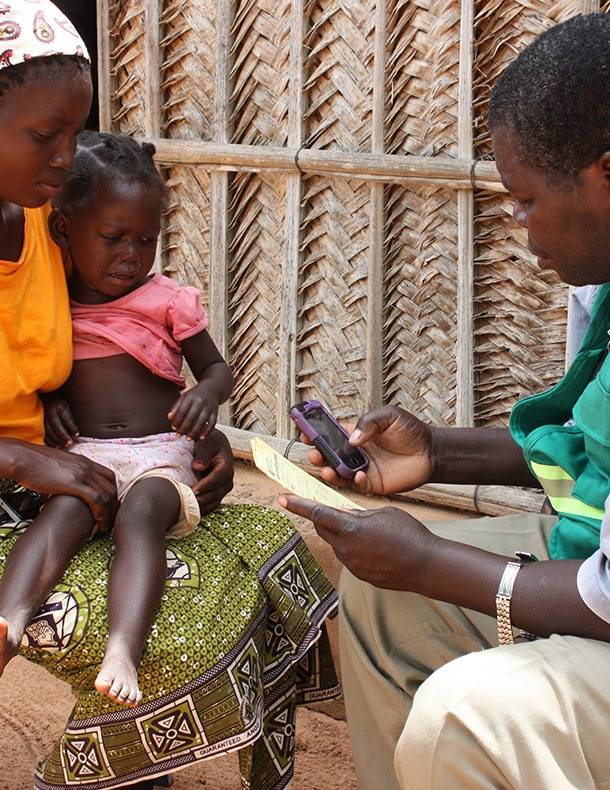
The REC guides nurses throughout regular consultations of patients under five years old, using decision support to apply IMCI and reduce the number of diagnostic and treatment errors. Nurses use the REC to register patients, record their vital signs, and input other relevant information in response to the application’s prompts. At each successive consult, the nurse can update the patient’s information and is prompted by the application with what immediate steps to take. For example, after a nurse identifies their patient’s symptoms, the REC determines the illness in real time and identifies proper treatment and an accurate dosage of medicine according to IMCI.
The application offers:
- Diagnosis according to the IMCI.
- Automatic posology according to the IMCI, based on the presentation of symptoms.
- A simplified user interface and intuitive application workflow with an easy learning curve.
- Data validation mechanisms to ensure data quality.
- Comparative data visualizations and warning-sign notifications.
“When we use the REC, we have to follow each single step of IMCI. This means that we scan all the health problems of a child. This requires that we ask all the IMCI questions and help us have a global diagnosis. This is a better management of the child.”
Healthcare Nurse
Measuring infant growth
The REC CommCare app uses the World Health Organization’s Child Growth Standards to determine measures such as weight-for-height, weight-for-age, and height-for-age, as well as mid-upper arm circumference. During visits, nurses enter the child’s current height, weight, temperature, and mid-upper arm circumference. On the next screen, the app displays a z-score and an icon for the standard deviation range presented for the WHO standards.
Based on the child’s resulting z-scores, the application produces icons that signal whether the child’s nutritional condition is ‘good’, ‘bad’ or in ‘danger’ and helps the nurse proceed with appropriate diagnosis and care. Using these tools, nurses can quickly determine whether a child is severely or moderately malnourished.
Implementation
The first year of the Integrated eDiagnostic Approach implementation was 2014. All system design and field-testing activities took place in the first year, in preparation for a roll out to 100 primary health clinics reaching 175,000 children by the end of the year. Now, the REC has been deployed to a total of 1,132 health facilities, reaching more than 200,000 children every month.
In addition to expanding the scope of the application to ante- and post-natal care, Dimagi and Terre des hommes are exploring opportunities to create built-in training and refresher course modules in the application. The aim of these modules is to help nurses retain their awareness of IMCI-related knowledge and practice long after they have initially been trained. They are also in the initial stages of implementing artificial intelligence capabilities to provide community health workers with real-time recommendations based on their performance history, as well as smart dashboards and predictive models for epidemiological surveillance. In the future, the REC will further expand the scope of its support to fighting malnutrition, offering antenatal and postnatal care, managing pharmacy stock levels, and providing vaccinations and immunizations.
“This is another advantage of [the Integrated eDiagnostic Approach]: it includes coaching and supervisions systems and enables us to improve health care workers’ training, making them more efficient at diagnosing and treating patients.”
Thierry Agagliate, IeDA Cofounder
Impact
Terre des hommes’ Integrated eDiagnostic Approach program has had a fantastic impact in terms of both the quality and reach of services provided. The initial investment in IT, infrastructure, and training created an opportunity for important synergies in the quality of services in primary health care facilities, the quality of care provided by community health workers, and long-term cost savings associated with reduced training times, paper consumption, and data submission times.
Initially, the REC sought to improve IMCI adherence to about 75% for consultations with children under five. Now, in health facilities using the Integrated eDiagnostic Approach, 97% of consultations with children under five use the tool, leading to a 50% improvement in adherence to the IMCI protocol. Data management has also improved, and measurements of community health workers’ actions regarding diagnosis and treatment are much more accurate.
In facilities using the Integrated eDiagnostic Approach, 97% of consultations with children under five now use the REC tool, leading to a 50% improvement in adherence to the IMCI protocol.
Community health workers using the REC were able to diagnose issues such as diarrhea, dysentery, and malnutrition with almost 20% higher accuracy than those who did not. Additionally, false-positive diagnoses of pneumonia were reduced by over 60%, over-prescription of antibiotics fell over 25%, and correct prescriptions for dysentery and malaria more than tripled.
“Without the REC, there are many questions we used to forget. But here, all the questions are listed and you cannot skip any of them. So to me, I think that we better manage patients. For example, when a child comes with a simple malaria, you can without the REC forget to identify anaemia.”
Healthcare Worker
The Integrated eDiagnostic Approach’s initial goal was to reach 620 health centers in Burkina Faso. Today, the system is in the hands of more than 4,800 health workers in 1,132 health facilities across the country. Since the launch of the program, it has helped 2.4 million children in more than 5 million consultations. In addition to improved care and coverage, the program also brings the potential of between $32 and $66 in cost savings per health facility per month.
Bringing decision support to your frontline workers?
Talk to our team about building a CommCare-powered diagnostic tool that improves the quality of care in your program.
Get in touch