In this post
The USAID-funded Healthy Mother, Healthy Baby (HMHB) Activity set out to improve health outcomes in Tajikistan through digital transformation. It expands USAID’s maternal, newborn, and child health (MNCH) and nutrition investments in Tajikistan as the country introduces new health strategies. It is a multi-year activity with a mandate to make sustainable improvements in the ability of the Government of Tajikistan to deliver quality maternal and child health and nutrition services, building technical capacity, leadership, and management while creating a path towards country-wide digitalization and policy reform.
Healthy Mother, Healthy Baby aims to improve the quality of healthcare, increase access to health services, and help meet the increasing demand for health services in 12 districts. It builds the capacity of health providers through in-service training and ongoing continuing education; integrates person-centered care across hospitals, Primary Health Care (PHC), and Healthy Lifestyle Centers (HLSCs); and supports an enabling environment for skilled, motivated providers by expanding Quality Improvement (QI) efforts and the availability of infrastructure and equipment. HMHB leverages the power of CommCare to create an enabling environment that strengthens capacity and ensures users have the correct information at their fingertips to make better-informed decisions.
The problem
In Tajikistan, women and children have benefited from the country’s commitment and strengthened capacity to improve maternal, newborn, and child health; however, the country continues to have the highest rates of maternal and child mortality and stunting, wasting, and underweight children in Central Asia.
Tajikistan struggles to provide timely and quality health care services for mothers and children. Registries on health service provision and data management are primarily paper-based, which delays services and impacts the quality of care. Digitizing health information is an effective way to improve coordination and expedite decision-making.
The solution
The Healthy Mother, Healthy Baby Activity builds on USAID’s prior work, including the Tajikistan Health and Nutrition Activity (THNA), whose goal was to improve the health status and nutrition of women and children living in 12 southwestern districts of the Khatlon Region. HMHB pursues its goal to improve the nutritional state and prevent morbidity and mortality of mothers and children under two, as well as improve the quality and availability of lifesaving evidence-based health interventions for women and children in the Feed the Future Zone of Influence (FTFZOI) in the Khatlon Region, as identified by USAID.
To deliver long-term country-led results, HMHB collaborates with the Ministry of Health and Social Protection of the Population (MoHSPP) to adapt MNCH and nutrition systems and interventions, and to strengthen local technical and organizational capacities to improve quality. HMHB uses CommCare to develop a suite of applications designed to help healthcare workers (HCWs) and community leaders increase the quality of services they deliver. Data from the program flows directly into the Abt Monitoring and Evaluation Ecosystem (AMEE)’s District Health Information Software 2 (DHIS2) instance and to a server at the Republican Center for Medical Statistics and Information to expedite decision-making.
Both CommCare and DHIS2 are open-source software systems used in many countries across the world, known as Global Goods. HMHB has a clear vision for how the mHealth tools will be developed and used throughout the project. HMHB’s technical team identified specific indicators that reflect the Activity’s priority strategic objectives as well as local and global strategies, and that reflect appropriate US Government (USG) standard indicators. The Dimagi team has worked closely with the HMHB team to enable the collection of data that informs these indicators using CommCare.
The applications
So far, CommCare has been used to develop the following applications for the HMHB program:
Rapid Health Facility Assessment (RHFA)
HMHB digitalized the World Health Organization’s (WHO) Rapid Health Facility Assessment (RHFA), originally developed in 2009. The RHFA provides a standardized way to measure progress to prevent morbidity and mortality of mothers and children under two, and to advance the availability and quality of lifesaving evidence-based health interventions for women and children. HMHB, in collaboration with the MoHSPP, adapted and digitalized the RHFA’s 2,000-plus questions using the open-source platform CommCare. It used the assessment as a baseline to effectively plan and implement activities at the Hospital and Primary Health Care levels.
In 2021, the digitalized RHFA app was used to assess 24 health facilities in Tajikistan (12 Primary Health Care and 12 District Central Hospitals). The results obtained from the RHFA application, which became available much sooner than before when conducted through paper-based tools, were used by HMHB to develop community nutrition and water, sanitation, and hygiene (WASH) roadmaps following USAID and global MNCH and nutrition best practices. HMHB also provided technical support and coordinated activities to resolve clinical or service issues identified during the RHFA to the MoHSPP.
This digital tool provides a multilevel data control and management system through the implementation of a supervisor role. All the data submitted by surveyors or consultants from different facilities is first made available to their supervisor, who can either reject the submission, upon which the surveyor edits and resubmits their forms, or directly edit the submitted forms. The final data is then made available for visualization on DHIS2.
HMHB adapted and digitalized the WHO’s 2,000-plus-question Rapid Health Facility Assessment in CommCare, and in 2021 used it to assess 24 health facilities (12 Primary Health Care and 12 District Central Hospitals).
Continuous Medical Education (CME)
The CME application supports the program’s investment in training and upskilling health care workers. It enables trainers, facility managers, and HMHB staff to track learning events and skills development milestones, from in-person trainings to online workshops. The app simplifies the process for MoHSPP Nutrition Resource Center (NRC) trainers to register and track the courses and trainings taken by health care workers, generating lists of trainees who have not completed modules or sub-topics by set dates. It also makes it easier for NRC trainers to track, analyze, and visualize the CME performance of health care workers.
This digital tool provides workflows for tracking education and trainings provided to Khatlon districts’ health staff, and tracking of topics trained at each PHC and Hospital NRC. It works as a digital job aid for NRC trainers, enabling them to digitally collect and see trainees’ training progress through tablets. The data collected is instantly available on DHIS2 for program administrators’ reporting and analytics needs.
Knowledge, Access and Practice (KAP)
HMHB led a household-level survey to collect baseline data on the community knowledge, attitudes, and practices (KAP) of Tajik families, with the aim of measuring HMHB’s program impact over time and informing decision-making at the MoHSPP. To implement this wide-scale household survey, HMHB built a KAP Survey application using CommCare. The app ensures household anonymity and segments inputs received from individual interviewees for deeper analysis. The insights generated by the KAP survey were particularly useful in understanding the distribution of decision-making responsibilities regarding nutrition and WASH in the household, which would in turn help in defining the social behavior change (SBC) audience for different behaviors.
This digital tool provides workflows for conducting knowledge assessment surveys of husbands, mothers of children under two years, and mothers-in-law within the community on various health topics such as Maternal and Newborn Child Health, Sanitation and Hygiene, and COVID-19 protocols. Responses from the community were anonymously collected and made available on DHIS2 for reporting and analytics.
Maternal Nutrition and Child Health (MNCH)
The MNCH app is divided into three versions, each with a different function and target audience:
- MNCH v1, Community Based Events (CBE), tracks HMHB activities, including community social behavior change events such as workshops for community workers, community leaders, and women and youth trainings, and peer mentoring sessions, at the district and village levels. The app is designed for HMHB facilitators and at the time of this writing has 463 users across 380 villages and facilities.
- MNCH v2, Antenatal and Postpartum Tracking, captures pre- and post-natal data to monitor and track pregnancies. The application helps facilitators and health care workers better support pregnant people to make healthier choices before and after their pregnancies. It includes a personalized visit scheduler enabling primary health care and village facility users to track patients, remind them of upcoming visits, and provide follow-up if visits are missed.
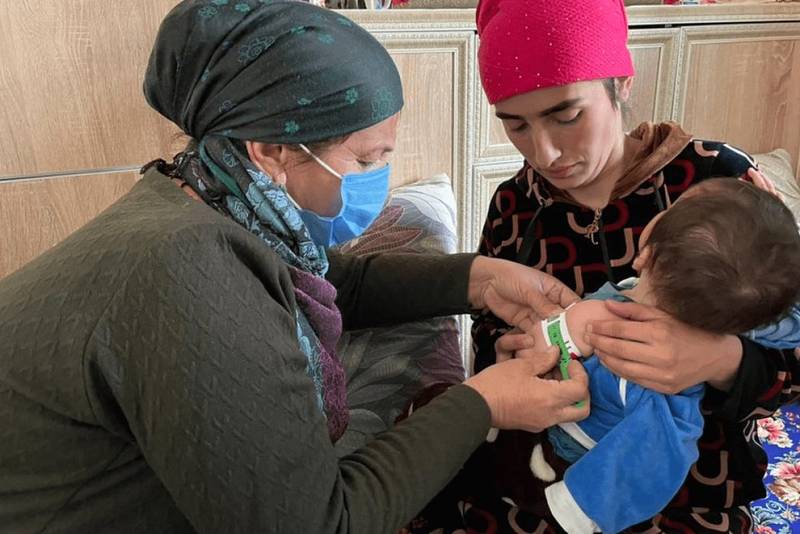
- MNCH v3, Children Under Five Tracking, currently in its design phase, will enable health care workers to capture and analyze nutrition and child development data for children under five. By capturing key health indicators such as height and weight for individual patients, health care workers can track progress towards improving MNCH and nutrition outcomes, and identify children most at risk of malnutrition so they receive immediate attention. By aggregating data collected at the facility level, the app further supports the MoHSPP and HMHB to make data-driven decisions.
One of the app’s customized features is the visit scheduler. All pregnant and lactating people, as well as children under five, have a visit scheduler that is fixed based on their last menstrual period or delivery date and date of birth. They are required to be visited by facilitators for check-ups and counseling on these dates. The application digitalizes this schedule so facilitators see a prioritized visit list with the name of the patient and the date of the next visit, making it a powerful tool to support their work.
DHIS2 integration
All the applications built on CommCare are also integrated with the DHIS2 system for easy data visualization and reporting. Integrating the widely used DHIS2 platform with CommCare, HMHB enables the MoHSPP to build a digital ecosystem that strengthens the skills of healthcare workers and managers, places healthcare data in the hands of decision-makers, and links communities to the healthcare system to increase service use and improve health outcomes.
Implementation and scale
To address MNCH and nutrition issues, USAID awarded Abt Associates the five-year HMHB Activity. In partnership with the MoHSPP, HMHB adapts, develops, and implements an approach based on global best practices. HMHB uses CommCare for data collection and as a job-aid tool for the targeted users, and DHIS2 to manage and analyze routine data. The project started in September 2020 and so far has had four applications launched in the field: RHFA (launched and live), CME (launched and live), KAP (launched and live in November 2021), and MNCH v1 (launched and live). MNCH v2 and v3 will be launched in the second quarter of 2022.
So far, Dimagi, through CommCare, is supporting HMHB for routine facility assessments, training and attendance tracking of health care workers, and recording community-based events such as community meetings, awareness-raising sessions, training, and social behavioral change communication (SBCC), and will soon start tracking pregnant people and children under five years of age. While the current number of users stands at around 600, and is expected to increase to approximately 1,800 by the end of 2022 in the Khatlon region alone, the systems are built for scale so that they can be spread across all the regions of Tajikistan.
Impact
HMHB has a clear vision for the mHealth tools to be developed and used throughout the project. The tools developed as part of the Activity have been built so that they can be scaled. To get to full-scale implementation at both a project and national level, it is important to be aware of and control the challenges that come with such plans. Through years of experience implementing and scaling digital systems, Dimagi brings a wealth of experience to HMHB that will be leveraged as the project plans a sustainable path to full-scale adoption of the systems. While the project is currently only in its second year of implementation, the coming years will see the HMHB team, including Dimagi, further pushing our impact to improve the nutrition and health outcomes of our target population, mothers and children, and continue supporting the overall digitalization efforts in Tajikistan.
“Partnering with Dimagi on the HMHB Activity in Tajikistan made sense. The Dimagi team brings decades of experience designing technology for frontline programs and truly cares about the outcomes of HMHB. We have been able to digitalize paper forms, increase the speed and accuracy of analysis to support decision making, and utilize CommCare for capacity building to improve performance quality of health workers. Together with Dimagi, HMHB is pushing the frontiers of impact in the digital health landscape of Tajikistan.”
Clifford Lubitz, Chief of Party, Healthy Mother, Healthy Baby
Strengthening a national health system?
Talk to our team about building a connected CommCare and DHIS2 ecosystem for frontline care.
Get in touch