In this post
Can early childhood development reach young children at national scale by riding on the health and nutrition programs that already exist? A cluster-randomized trial in rural Madagascar set out to answer that question, layering structured ECD stimulation onto an existing community nutrition program and using CommCare to track every session in the field.
Source: “Integrating early child development into an existing health and nutrition program: evidence from a cluster-randomized controlled trial,” BMC Public Health 24, 2583 (2024). Open access.
Reaching the youngest children at scale
The first 1,000 days shape a child’s cognitive and physical development for life, yet structured early stimulation rarely reaches families in low-resource rural settings. Building a standalone ECD service for every village is expensive. The more promising path is integration: adding developmental stimulation to the health and nutrition contacts that community health workers already deliver. The open question is whether integration actually works, or whether asking community workers to do more simply crowds out the services families came for.
A cluster-randomized trial in the central highlands
Researchers ran the trial across 75 communities in two regions of Madagascar’s central highlands, Amoron’i Mania and Haute Matsiatra, reaching 9,408 children aged 6 to 30 months and their caregivers. The MAHAY Mikolo program delivered age-specific stimulation activities through twelve fortnightly group sessions over six months, led by the same community health workers who run the existing nutrition program. One treatment arm added take-home toy boxes and rotating book libraries to test whether materials in the home would deepen engagement.
Tracking every session on CommCare
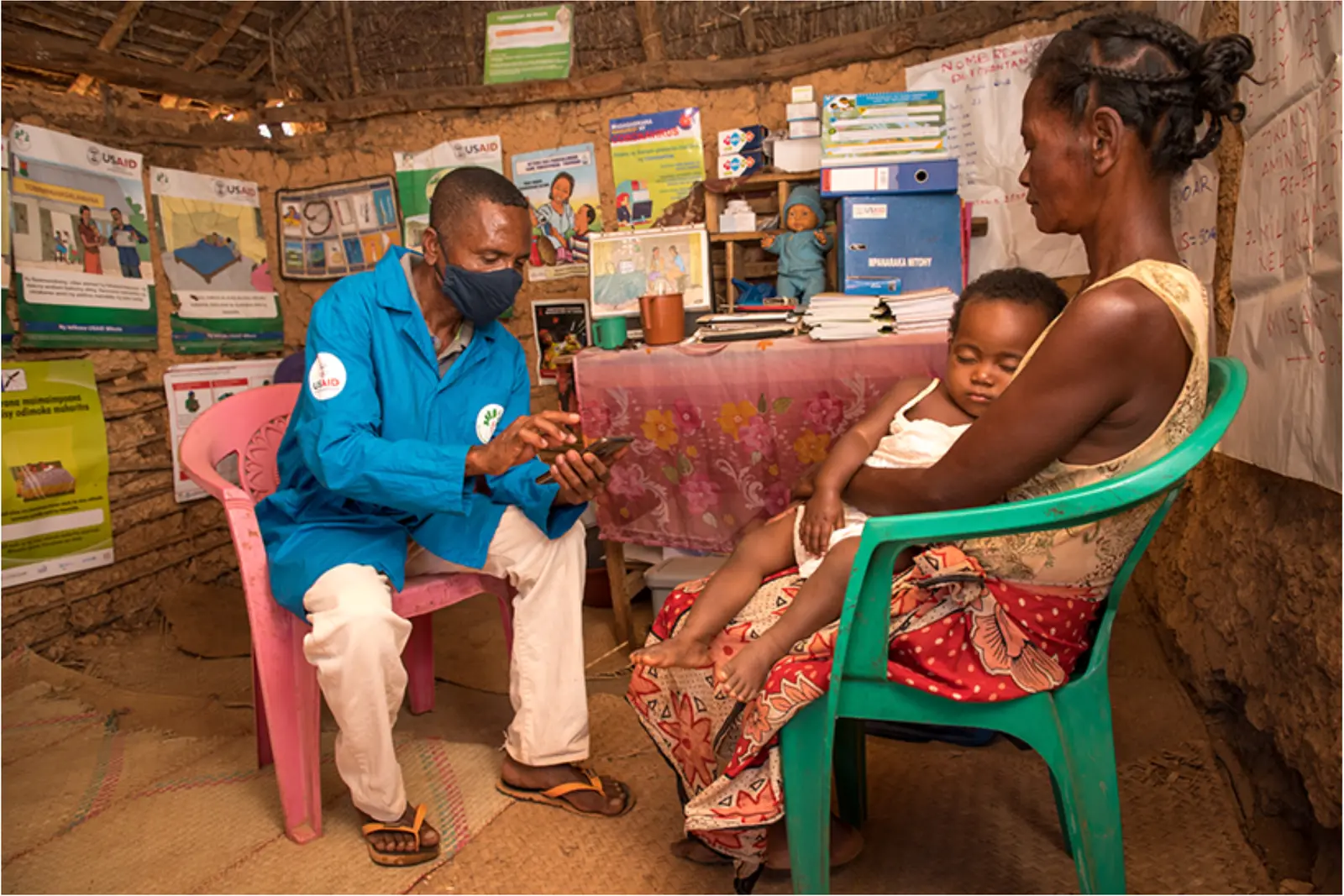
To measure feasibility honestly, the team needed reliable attendance data from dozens of villages. Attendance records were collected, entered using tablets, and uploaded to a digital data platform, CommCare, by non-governmental organization (NGO) supervisors as part of their monthly routine tasks. For each ECD session, the records captured a unique identifier for every child who attended, which caregiver came with the child, and, in the arm that offered take-home materials, whether the child borrowed toys or books. That gave the researchers a continuous, village-level record of who attended what, the foundation for an analysis of whether the new ECD offer pulled families away from existing services.
What the data showed
Community health workers ran 95% of planned ECD sessions, balanced across study groups, without reducing families’ attendance at the existing health and nutrition sessions.
The program proved deliverable: 95% of planned sessions were conducted, balanced across the study groups, and 30% of eligible children registered in the first cycle and 32% in the second. Crucially, offering ECD sessions had no significant effect on families’ monthly attendance at the existing health and nutrition sessions, evidence that integration did not crowd out the core program. Adding take-home toy boxes and a rotating toy and book library did not raise monthly ECD attendance for most children, though it gave a modest lift of about 4 percentage points among children who had not attended in the first cycle. Children from wealthier households, those who already attended the health and nutrition sessions regularly, those in less populated sites, and those in the region closer to the capital were the most likely to enroll, a reminder that integration alone does not automatically reach the hardest-to-reach.
Why it matters for integrated ECD
The trial offers practical evidence that early childhood development can be folded into an existing community nutrition platform without sacrificing the services already in place, and that a frontline workforce can deliver it with high fidelity when given simple digital tools to manage and monitor the work. The findings also sharpen the next question for program designers: how to lift enrollment among the families who need stimulation most. Full methods and results are published open-access in BMC Public Health.
See what CommCare can do for your program
Talk with our team about digitizing service delivery and monitoring for your frontline workforce.
Get in touch