Earlier research suggested that mass drug administration (MDA) of the antibiotic azithromycin could reduce child mortality, though the effect varied by setting. The LAKANA trial in Mali is testing the idea rigorously, and its published study protocol names CommCare as the tool its field teams use to collect the data.
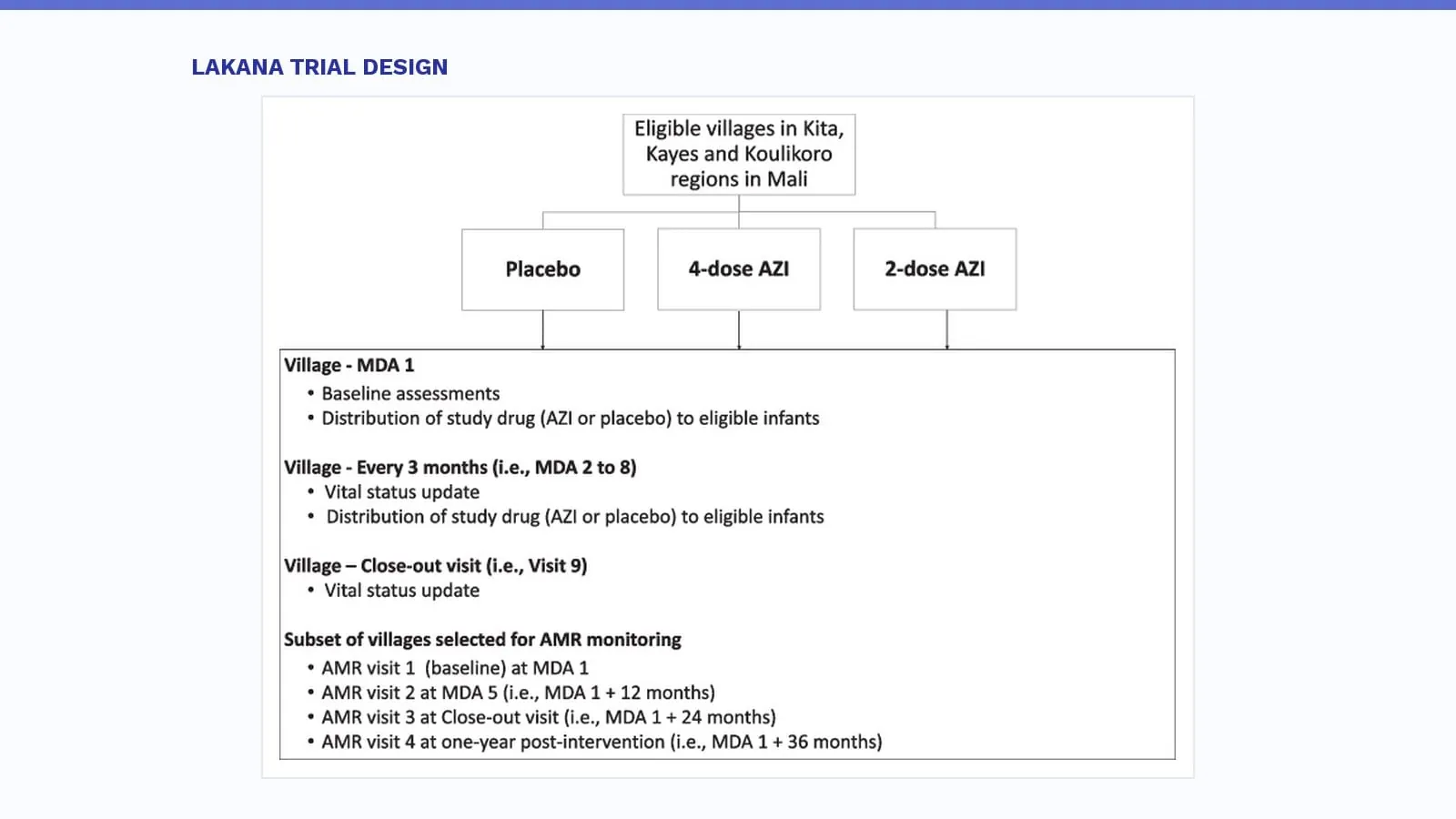
Source: Adubra L, Alber D, Ashorn P, et al. “Testing the effects of mass drug administration of azithromycin on mortality and other outcomes among 1–11-month-old infants in Mali (LAKANA): study protocol for a cluster-randomized, placebo-controlled, double-blinded, parallel-group, three-arm clinical trial.” Trials 24, 5 (January 3, 2023). Open access under CC BY 4.0. The image above is Figure 1 from that protocol.
A three-arm trial at scale
LAKANA (Large-scale Assessment of the Key health-promoting Activities of two New mass drug administration regimens with Azithromycin) is a cluster-randomized, placebo-controlled, double-blinded, parallel-group, three-arm clinical trial with an adaptive design. It runs across the Kayes, Kita, and Koulikoro regions of Mali. The study protocol was published in the journal Trials in January 2023.
The trial is conducted in 1,150 villages. Villages are randomly allocated to three groups in a ratio of 3:2:4. Infants aged one to eleven months (29 to 364 days) are enrolled, with a planned target of about 35,650 infants and follow-up over 24 months. The three arms are:
- Placebo (control): four annual rounds of placebo.
- Four annual doses of azithromycin: azithromycin delivered quarterly, four rounds per year.
- Two annual doses of azithromycin: azithromycin twice a year (January to June), with placebo in the other two rounds (July to December).
The setting is a high-mortality, malaria-holoendemic part of Mali where the national malaria control program already delivers seasonal malaria chemoprevention (SMC) to children during the peak transmission season, from July to October.
LAKANA plans to enroll roughly 35,650 infants across 1,150 Malian villages, with all data captured on CommCare.
Why the data layer matters
A trial of this size lives or dies on data quality. The primary outcome is all-cause mortality, measured as deaths per 1,000 years at risk among children aged one to eleven months, so every birth, dose, visit, and death has to be recorded accurately across hundreds of villages and repeated treatment rounds.
The protocol describes the tool directly: “All data are collected electronically on tablet devices with a custom-designed mobile application (CommCare by Dimagi, Cambridge, MA, USA) and uploaded regularly to a secure, cloud-based server, with real-time monitoring ensured by error and inconsistency checks at data entry via validation logic rules, mandatory fields, and value range checks.”
Alongside mortality, the trial tracks secondary outcomes including antimicrobial resistance, morbidity, growth and nutritional status, safety, biological mechanisms, and questions of feasibility such as acceptability, equity, health system compatibility, and economic analysis.
It is worth being precise about what this evidence is: LAKANA is a study protocol and an ongoing trial, not a finished result. What the protocol establishes today is that CommCare serves as the tablet-based data backbone for one of the larger child-survival trials underway in West Africa.
Designing a large field trial?
Talk to our team about CommCare for enrollment, dosing, and follow-up data collection at scale.
Get in touch