RTI International launched the USAID/Cambodia-funded Integrated Early Childhood Development (IECD) Activity in July 2020 to support children to thrive and reach their full developmental potential. The IECD Activity aims to promote nurturing care for the most vulnerable newborns and young children, starting before birth. It supports child development holistically, through a multi-sectoral approach that strengthens nutrition service delivery at health facilities and in communities, supports nutrition-sensitive agriculture and improved livelihoods, improves water, sanitation, and hygiene practices among caregivers, and promotes responsive caregiving to help children meet critical cognitive, linguistic, socio-emotional, and physical developmental milestones. Focus is on the early childhood years, with an emphasis on the first 1,000 days, for more intensive nutritional, psychosocial, and physical stimulation interventions. IECD supports developmental milestone screening to enable the early identification of and interventions for children with developmental delays or who are at risk for impairments and disabilities.
The problem
Despite rising incomes and other advances in Cambodia, persistent challenges inhibit the healthy growth of the country’s youngest children. More than 30 percent of Cambodian children between the ages of 3 to 5 years old are behind in reaching their developmental milestones, and about 32 percent of children under five years old are stunted, or short for their age, due to malnutrition and other deficiencies. Cambodian children in vulnerable households suffer from poor nutrition and food insecurity, particularly in rural areas. An estimated 3 million Cambodians lack access to safe drinking water and 6.5 million lack access to adequate sanitation. As a result, many young children face barriers to reaching their full potential.
The solution
With support from the United States Agency for International Development (USAID), the Cambodia Integrated Early Childhood Development (IECD) Activity works to advance the physical, cognitive and social development of young children, improve their nutrition, and help ensure that children with developmental delays and disabilities receive appropriate care.
App overview
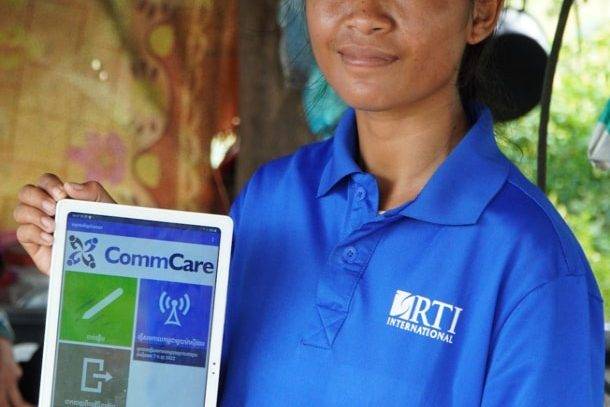
The IECD Cambodia platform is comprised of three CommCare mobile applications:
- The Cohort Evaluation (CE) app allows enumerators to collect impact evaluation data from participants enrolled in a longitudinal study. At each wave of data collection, the app allows the research team to follow changes in household data over time and link child data and caregiver data within households.
- The Minimum Viable Product (MVP) app serves as a job aid for Community Health Workers (CHWs) to provide integrated diagnostics and counseling services to households in their communities. This is the core application, directly focused on integrated early childhood development: registering households, providing a job aid to screen children and conduct home visits, supporting the creation and follow up of referrals, tracking group activity attendance, and more.
- The Performance Monitoring Service Protocol (PMSP) app supports enumerators in ongoing data collections to evaluate activities across households. It consists of surveys for agriculture, farm management and technology, nutrition, and social and behavioral change.
Feature highlight: repeat groups
RTI had previously captured survey data in detailed spreadsheets, which made errors in data entry highly likely. As a result, Dimagi built out a series of questionnaires in the PMSP application that allows enumerators to follow these data collection sheets line by line through a series of repeat groups.
Repeat groups are an advanced CommCare functionality that allows data collection to iterate through a series of questions. For example, a farmer says she grows 3 types of crops, so the app needs to ask her the same types of questions for each crop. This feature allows the app to ask only the minimum number of questions necessary, and the application can extend or decrease in length based on the client’s specific situation. If a farmer only grows one crop, then there is no repeat; if a farmer grows 3 crops, then 2 repeats, and so on.
In implementing this feature, we have ensured that users are focused on entering only the specific data points that are on their screen at one time, improving user experience as well as the quality of data collection.
Implementation
In August 2020, RTI began a new five-year project to support the Royal Government of Cambodia’s efforts to improve child development for children under five years of age. With support from USAID, the Cambodia Integrated Early Childhood Development (IECD) Activity will work to advance the physical, cognitive and social development of young children, improve their nutrition, and help ensure that children with developmental delays and disabilities receive appropriate care.
RTI partnered with Dimagi in February 2021 for 14 months of app building support to digitize their workflows and provide job aids for CHWs. Over the course of the engagement, the project has successfully digitized the registration of over 5,000 households and 25,000 household members across two provinces in Cambodia. Dimagi is currently working with RTI to formalize support for another 18 months so that RTI can successfully double the number of users.
“The app has been designed to house all program manuals and job aids to support the CHWs to implement IECD activities in their communities. We have received very positive feedback from them that the app is user friendly and effective [because it offers features such as] availability in local language, offline data collection, real time data, and ability to track individuals’ exposure to interventions.”
Seng Yeng, M&E Manager, RTI Cambodia
In 14 months of app building support, the IECD Activity digitized the registration of over 5,000 households and 25,000 household members across two provinces in Cambodia.
Impact
The IECD CommCare apps have lightened the load on community health workers and freed up time for the families they serve.
“Within the IECD CommCare app, CHWs have the benefit of less paper-based work, a simpler process for tracking information, and more time for positive interaction with caregivers. These benefits help us deliver services such as caregiver education, disability screening, nutrition promotion, and agriculture for income generation, to support vulnerable families and young children.”
Seng Yeng, M&E Manager, RTI Cambodia
Designing job aids for frontline workers?
Talk to our team about turning paper protocols into offline CommCare job aids.
Get in touch