In this post
Every year, upwards of 400,000 children are born with sickle cell disease (SCD), a genetic disease that stiffens red blood cells and distorts their normal round shape, causing many complications including frequent episodes of pain, acute lung injury, stroke, overwhelming infection, and chronic organ damage. Three-quarters of these children live in sub-Saharan Africa. The World Health Organization (WHO) estimates that 70% of deaths associated with SCD are preventable with simple, cost-effective interventions, such as early detection through newborn screening and the subsequent provision of comprehensive care. Since 2017, Dimagi has partnered with the Sickle Cell Foundation of Ghana (SCFG) to support the National Newborn Screening Program (NNSP) by digitizing its paper forms and serving as a job aid to its users. To date, more than 12,500 newborns have been registered through the mobile application built on CommCare, at six sites across two districts in Ghana.
The problem
The majority of babies born with SCD start to experience their first symptoms, such as the swelling of their hands and feet, when they are about five to six months old. But in countries across Africa, 50 to 90% of undiagnosed children will die before the age of five without ever being treated for the disease.
Today, two percent of Ghanaian babies are born with SCD. Ghana is one of the few countries in sub-Saharan Africa that has a newborn screening program, but according to Prof. Kwaku Ohene-Frempong, President of the SCFG, there is not a single country in Africa that tests all of their children for SCD.
“Screening is currently established at 40 sites, but reaches only about 4 percent of all newborns.”
Prof. Kwaku Ohene-Frempong, President, Sickle Cell Foundation of Ghana
According to a pair of studies carried out in 1997 and 2007, clinical care in health facilities at the district level is basic and sometimes lacking, despite the fact that 25% of the population are carriers and 2% of all babies born, that is 1 in 50 live births, have a form of SCD. However, the studies also found that in one city that implemented the first newborn screening program in Africa, treated patients survived 95% of the time.
The solution
Realizing large-scale, universal screening could save the lives of up to 9 million newborns in sub-Saharan Africa before 2050, the SCFG established a partnership of organizations aimed at preventing SCD child deaths in Ghana through the expansion of universal newborn screening and improved treatment. As part of this partnership, Dimagi worked with the Foundation to support the NNSP by digitizing its paper forms and developing a mobile job aid for its users.
App overview
The SCFG developed a CommCare-based application to support the NNSP by replacing older paper forms across a number of different areas:
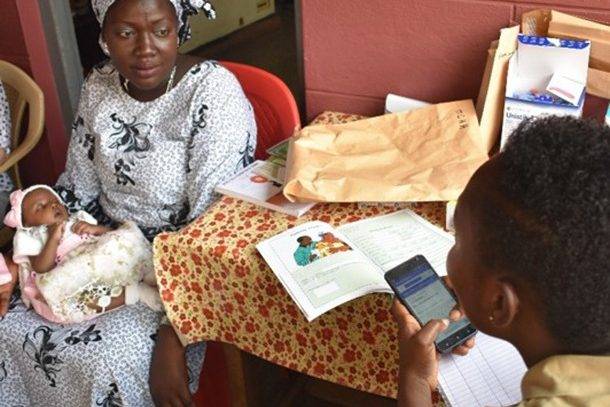
- Registration of samples and family contact information, bypassing paper forms.
- Tracking of samples from screening sites to the lab in Accra.
- Entering of lab results and real-time distribution of results.
- Contacting, following up, and enrolling children with presumptive SCD (P-SCD) into the specialized pediatric clinic at Komfo Anokye Teaching Hospital.
- Reliable monitoring of children through a specialized workflow involving the doctors.
Feature highlight: case list filtering for improved clinic enrollment
At the Ghana newborn screening sites, babies born in a health facility or at home are screened for sickle cell disease before they leave the facility or at their first immunization visit, respectively. The difficult part is locating them again once their lab results are in.
Maternity or community health nurses record as many pieces of information about the mother and father as possible: full names, up to three phone numbers, home address, landmark near home, place of work, occupation, landlord name, and landlord’s phone number. These pieces of information help, but locating the family is still not always straightforward. While there are some “extreme” cases of incorrect phone numbers or addresses provided, it is more often that phones are out of service or the users have switched the SIM card.
With a paper-based system, it was difficult to know how well tracking and follow-up was being handled, and cases would fall through the cracks if the patient could not be found quickly. To combat this, the team at the SCFG added a “smart agenda” to their application, which ensures that the health workers follow through with every child. Because a verified person must manually close each case and specify the reason, each case is always listed somewhere and cannot get lost at the bottom of a stack of papers.
The app has numerous built-in checks, which do not allow for a case to be falsely marked as “lost.” For instance, a user cannot select the “lost to follow up” option unless six months have passed from the date of the test result.
Implementation
The app was launched in November of 2017 and is being used in birth centers in two regions of Ghana. In the future, it is expected to become part of a comprehensive set of SCD applications for use throughout Ghana to facilitate patient management and hydroxyurea treatment, and to provide targeted educational materials about the disease and treatment to patients and their caregivers. It is run by a small team of 40 nurses, one nurse coordinator, three lab technicians, and three project staff for supervision.
Impact
A brief review after 18 months in action shows high and steady usage of the CommCare-based application. To date, more than 12,500 newborns have been registered through the app, with more added every day.
More than 12,500 newborns have been registered through the app across six sites in two districts of Ghana, with more added every day.
Digitizing a screening or registry program?
Talk to our team about building reliable patient tracking and follow-up on CommCare.
Get in touch