
Housing insecurity reached new heights across the United States in 2020, hitting Vermont particularly hard post-pandemic, with homelessness increasing more than twofold between early 2020 and 2021.
But while this post-Covid surge initially rattled state health leaders, who recognized the health risks faced by individuals in need of housing, it underscored an important, unresolved problem: despite the state’s best efforts, hundreds of individuals and families continue to fall through the cracks because of fragmented care every year, failing to secure the housing and health services they urgently need.
Yet while solving a huge problem like housing insecurity seemed insurmountable, the last six months have proven that the right care coordination technology, combined with targeted efforts, can make an outsize, positive impact.
Assessing challenges
Between 2020 and 2022, approximately 12,000 households received hotel and motel vouchers to keep them sheltered, paid for by federal Covid relief funds. The Vermont Department for Children and Families serves about 1,800 households on any given night. In Summer 2022, the Department launched a motel-based Transitional Housing Program supported by the federal Emergency Rental Assistance Program.
This temporary, federally funded Transitional Housing Program was due to end March 31st, 2023, and additional supports were needed to reach households in motels to help them connect to health, employment and housing resources and programs. The Vermont Agency of Human Services reimagined care coordination for households in need, to support participants as federal funding was expended.
Knowing that care coordination would only work with the right tech support and dedicated staff, the Agency of Human Services brought together four organizations: the Department of Disabilities, Aging and Independent Living; Vermont Chronic Care Initiatives (health resources); the Department for Children and Families; and community housing navigation services. These partners set out to create and operationalize a team-based care model, bringing together multiple teams in charge of assessing needs, determining chronic care needs, and assessing additional employment and disability support as needed. Stakeholders hoped to leverage a technology platform to streamline collaboration among these teams, to improve housing assistance in a way that would make a measurable impact.
Stakeholders also hoped that using the technology platform as the central hub would help unify state programs tasked with owning multiple aspects of improving access to health care and employment services, and leverage existing resources such as the federally funded Homeless Management Information System (HMIS).
Taking a new approach
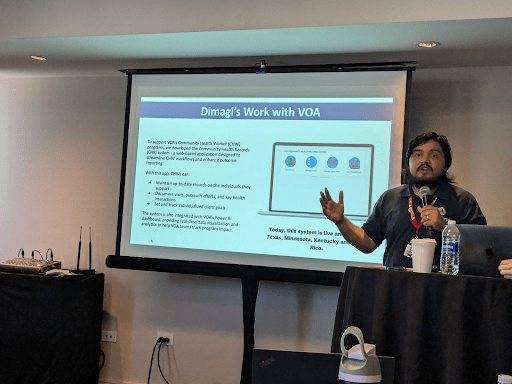
In 2022, the Agency of Human Services partnered with Dimagi to implement its low-code, configurable CommCare platform to achieve these goals, and facilitate collaboration between these four agencies and their teams.
While configuring and launching a new technology solution can often take months or years, the CommCare Transitional Housing care coordination solution took just three weeks to build and launch. Dimagi’s team worked closely with Vermont agency leaders to outline goals and develop a roadmap for executing them, develop a robust reporting dashboard to track progress of the Transitional Housing Program (THP), and roll out a minimum viable product just three weeks post contracting.
Measuring progress
Today, 7 months since launch, the program has led to measurable results:
- Faster electronic health and employment screenings for individuals experiencing homelessness.
- Speedy referral of individuals in need of specific services that would reduce housing insecurity (e.g., job training, support with substance use disorder).
- Implementation of a new, unified screening system, resulting in the screening and Shared Care Plan creation of adults in 937 of the 1,171 households that gave consent.
- The addition of new collaborative goals with designated care team members (e.g., housing and/or job assistance) for 715+ members to avoid future homelessness.
Consenting households received a screening and a Shared Care Plan through the new unified system.
Next steps
Moving forward, the State hopes to leverage lessons learned from its successes on this project to design and implement additional team-based care programs for new use cases.
“This project ensures Vermonters living in pandemic federally funded emergency housing have an additional opportunity to connect with services before the program comes to an end. The outreach has provided a better understanding of people’s needs and priorities. Data gathered created a framework for discussions around barriers, service opportunities, and generally where we go from here. The entire project is an example of how team-based support, interagency collaboration, and a data solution can work to serve Vermonters.”
David Riegel, Director of Housing Policy and Planning, State of Vermont Agency of Human Services
Have a care coordination challenge?
See how the right technology, paired with targeted efforts, can help your teams make a measurable impact.
Get in touch