| 2025 | Peer-reviewed | Frontline worker | Guatemala | Duffy 2025 Duffy S, Valley TM, Chavez A, et al. Community Health Workers Equipped with an mHealth Application Can Accurately Diagnose Hypertension in Rural Guatemala. Glob Heart. 2025;20(1):39. doi:10.5334/gh.1423 “Calculated overall diagnostic accuracy for CHWs was 93% (95% CI = 90.4%, 95.7%).” | View Duffy 2025 → |
| 2025 | Peer-reviewed | Feasibility | Sierra Leone | Pognon 2025 Pognon PR, Boima F, Mekonnen ZA. Health Workers’ Acceptance and Satisfaction on the Usability of the Digital Health Goods, in Kono District, Sierra Leone. Journal of Multidisciplinary Healthcare. 2025;18:1067-1079. doi:10.2147/JMDH.S509441 “The study findings showed that CommCare users are more likely to have higher acceptance as compared to [Electronic Medical Record] users” | View Pognon 2025 → |
| 2025 | Peer-reviewed | Feasibility | Nigeria | Omotayo 2025 Omotayo SA, Chukwuogo O, Ogbudebe C, et al. Finding missing TB cases in Northern Nigeria. Public Health Action. 2025;15(1):38-43. doi:10.5588/pha.24.0045 “64,079 people with presumptive TB were identified, of which 10.1% were diagnosed with TB and 97% of those diagnosed were placed on treatment.” | View Omotayo 2025 → |
| 2025 | Peer-reviewed | Frontline worker | Ethiopia | Beza 2025 Beza L, Alemayehu B, Pelkmans J, Gary R. Utilizing Mobile Phone Technology to Optimize Cardiovascular Disease Risk Screening by Health Extension Workers in Ethiopia. World Journal of Cardiovascular Diseases. 2025;15(6):278-297. doi:10.4236/wjcd.2025.156024 “HEWS identified with equal accuracy as master's prepared nurses those in the community at high, moderate and low CVD risk using the non-laboratory risk score algorithm via a mobile health app.” | View Beza 2025 → |
| 2024 | Peer-reviewed | Feasibility | Many / Unspecific | Agbeyangi 2024 Agbeyangi A, Suleman H. Advances and Challenges in Low-Resource-Environment Software Systems: A Survey. Informatics. 2024;11(4):90. doi:10.3390/informatics11040090 “The study reveals that despite noteworthy progress, unresolved challenges persist, necessitating further attention to enable the optimal performance of software systems in low-resource environments.” | View Agbeyangi 2024 → |
| 2024 | Grey literature | Feasibility | Burkina Faso | Lazenby 2024 Lazenby S, Mason C, Stuhldreher R, Kimball M, Bartlein R. Three-Layer Health Sector Investment: Digital Health Interventions for Pandemic Preparedness in Low- and Middle-Income Countries. In: Strategic Investment for Health System Resilience: A Three-Layer Framework. Washington, DC: World Bank; 2024. doi:10.1596/978-1-4648-2116-5 “By June 30, 2021, it is expected to cover 84 percent of PHC facilities (1,755) across 54 districts.” | View Lazenby 2024 → |
| 2024 | Peer-reviewed | Feasibility | Somalia | Farid 2024 Farid M, Ibrahim A, Mohammad H, et al. COVID-19 vaccination campaigns in fragile and conflict-affected settings, Somalia. Bull World Health Organ. 2024;102(9):674-680. doi:10.2471/BLT.23.291105 “By 31 December 2022, 42.1% (6 597 293/15 670 530) of the population had completed the primary COVID-19 vaccination – 36.6% in 2022 versus 5.5% in 2021” | View Farid 2024 → |
| 2024 | Peer-reviewed | Feasibility | Nepal | Delawalla 2024 Delawalla M, Morgan B, Guo B, Drain P. Public-private partnership in Nepal. Gates Open Res. 2024;8(92):92. doi:10.21955/gatesopenres.1117133.1 “CHWs use Android-based mobile phones with the CommCare application to collect data, view task reminders, and access decision support and counseling tools, even when the phone is offline.” | View Delawalla 2024 → |
| 2024 | Peer-reviewed | Frontline worker | Somalia | Hürlmann 2024 Hürlimann E, Landi M, Miikkulainen A, et al. Impact of digital clinical decision support on quality of care and antibiotic stewardship for children under five in South-Central Somalia. Oxford Open Digital Health. 2024;2(Supplement_2):ii32-ii44. doi:10.1093/oodh/oqae029 “Out of the 116 antibiotic treatments for children being diagnosed with URTI pre-ALMANACH, 112 (96.6%) should not have resulted in an antibiotic prescription according to clinical guidelines whereas only one of the 32 antibiotic treatments in the post-implementation round was considered unreasonable.” | View Hürlmann 2024 → |
| 2024 | Peer-reviewed | Feasibility | Colombia | Caceres Rivera 2024 Rivera DIC, Rojas LMJ, Rojas LZ, Gomez DC, Ruiz DAC, Romero LAL. Using Principles of Digital Development for a Smartphone App to Support Data Collection in Patients With Acute Myocardial Infarction and Physical Activity Intolerance: Case Study. JMIR Formative Research. 2024;8(1):e33868. doi:10.2196/33868 “The agreement between the evaluators was approximately 80% for most of the defining characteristics.” | View Caceres Rivera 2024 → |
| 2024 | Peer-reviewed | Feasibility | USA | Poudyal 2024 Poudyal A, Lewis DM, Taha S, et al. Designing an App to Support Measurement-Based Peer Supervision of Frontline Health Workers Delivering Brief Psychosocial Interventions in Texas: Multimethod Study. JMIR Formative Research. 2024;8(1):e55205. doi:10.2196/55205 “Participants found the app to be usable, with an average System Usability Scale score of 72.5 (SD 18.1), consistent with the industry benchmark of 68.” | View Poudyal 2024 → |
| 2024 | Peer-reviewed | Feasibility | Mexico | Aranda 2024 Aranda Z, Vázquez S, Gopaluni A, et al. Evaluation of the implementation of a community health worker-led COVID-19 contact tracing intervention in Chiapas, Mexico, from March 2020 to December 2021. BMC Health Serv Res. 2024;24(1):97. doi:10.1186/s12913-024-10590-3 “From a roster of 2,177 named contacts, 1,187 (54.5%) received at least one home visit by a CHW and 560 (25.7%) had successful completion of contact tracing according to intervention guidelines.” | View Aranda 2024 → |
| 2024 | Peer-reviewed | Feasibility | India | Singla 2024 Singla DR, Fernandes L, Savel K, et al. Scaling up the task-sharing of psychological therapies: A formative study of the PEERS smartphone application for supervision and quality assurance in rural India. Cambridge Prisms: Global Mental Health. 2024;11:e20. doi:10.1017/gmh.2024.11 “In general, most treatment providers and clinical experts reported encountering more facilitators than barriers when using the app, indicating the majority of responses for key themes related to acceptability (user experience and adherence) and feasibility (app effectiveness).” | View Singla 2024 → |
| 2023 | Peer-reviewed | Frontline worker | Mozambique | Karajeanes 2023 Karajeanes E, Bila D, Luis M, et al. The InfomóvelAn information system for managing HIV/AIDS patients in rural areas of Mozambique. BMC Med Inform Decis Mak. 2023;23(1):187. doi:10.1186/s12911-023-02281-6 “the platform located 1,673 (90%) of the index patients (patients in ART default)” | View Karajeanes 2023 → |
| 2023 | Peer-reviewed | Feasibility | Kenya | Lyles 2023 Lyles E, Paik K, Kiogora J, et al. Adoption of Electronic Medical Records for Chronic Disease Care in Kenyan Refugee Camps: Quantitative and Qualitative Prospective Evaluation. JMIR mHealth and uHealth. 2023;11(1):e43878. doi:10.2196/43878 “The number of visits, BMI, physical activity, and next visit were frequently reported in the NCD app (≥99%) but not in the EMR (≤15%).” | View Lyles 2023 → |
| 2023 | Peer-reviewed | Frontline worker | Burkina Faso | Maïga 2023 Maïga A, Ogyu A, Millogo RM, et al. Use of a digital job-aid in improving antenatal clinical protocols and quality of care in rural primarylevel health facilities in Burkina Faso: a quasi-experimental evaluation. BMJ Open 2023;13:e074770. doi:10.1136/ bmjopen-2023-074770 “The intervention arm had a significantly higher score difference in women's knowledge of received counselling (16.4 points, 95% CI 10.37 to 22.49)” | View Maïga 2023 → |
| 2023 | Peer-reviewed | Feasibility | Many / Unspecific | Wallis 2023 Wallis K, Mwangale V, Gebre-Mariam M, Reid J, Jung J. Software Tools to Facilitate Community-Based Surveillance: A Scoping Review. Global Health: Science and Practice. 2023;11(5). doi:10.9745/GHSP-D-22-00553 “All of the tools reviewed have features necessary to support the reporting process of CBS; only 3 (CommCare, Community Health Toolkit, and DHIS2 Tracker) provided all 10 attributes included in the mapping.” | View Wallis 2023 → |
| 2023 | Peer-reviewed | Frontline worker | Uganda | Källander 2023 Källander K, Soremekun S, Strachan DL, et al. Improving community health worker treatment for malaria, diarrhoea, and pneumonia in Uganda through inSCALE community and mHealth innovations: A cluster randomised controlled trial. PLOS Digital Health. 2023;2(6):e0000217. doi:10.1371/journal.pdig.0000217 “Appropriate treatment was 11% higher in the mHealth compared to the control arm (risk ratio [RR] 1.11, 95% CI 1.02, 1.21; p = 0.018).” | View Källander 2023 → |
| 2023 | Peer-reviewed | Feasibility | USA | Jenny 2023 Jenny A, Maher A, Foreman A, et al. Rapid and sustained contact tracing training for COVID-19 in San Francisco: a training model for developing an emergency public health workforce. Published online 2023. doi:10.3389/fpubh.2023.1125927 “Our performance-based evaluation, which had a participation rate of 61% (n = 118), had a 98% pass rate on the first attempt by trainees based on the rubric.” | View Jenny 2023 → |
| 2023 | Peer-reviewed | Feasibility | India | Bhaise 2023 Bhaise S, Patel A, Dhurde V, et al. Development of mobile phone-based dietary data collection applications in pregnant women and infants for the M-SAKHI trial. Journal of Nutritional Science. 2023;12:e124. doi:10.1017/jns.2023.95 “The Apps were user-friendly, required minimal prior training, had built-in validation checks for erroneous data entry and provided automated calculations.” | View Bhaise 2023 → |
| 2023 | Peer-reviewed | Frontline worker | Nepal | Tiwari 2023 Tiwari A, Thapa A, Choudhury N, et al. A Type II hybrid effectiveness-implementation study of an integrated CHW intervention to address maternal healthcare in rural Nepal. PLOS Global Public Health. 2023;3(1):e0001512. doi:10.1371/journal.pgph.0001512 “There was, on average, a 30% increase in IBR (p<0.0001) post-intervention as compared to pre-intervention, adjusting for other variables.” | View Tiwari 2023 → |
| 2023 | Peer-reviewed | Feasibility | Many / Unspecific | Hamani 2023 Hamani A, Hussein Jama I, Roland MAY, et al. Mobile Money and the importance of timely, complete payments to frontline health campaign workers in the fight to eradicate polio: pilot experience from a World Health Organization digital payment platform in Africa. BMC Health Services Research. 2023;23(1):16. doi:10.1186/s12913-022-08990-4 “In rounds 1, 2 and 3, 99.6%, 99.6%, and 99.9% of payments, respectively, were made successfully to workers.” | View Hamani 2023 → |
| 2023 | Peer-reviewed | Frontline worker | Mozambique | Soremekun 2023 Soremekun S, Källander K, Lingam R, et al. Improving outcomes for children with malaria, diarrhoea and pneumonia in Mozambique: A cluster randomised controlled trial of the inSCALE technology innovation. PLOS Digital Health. 2023;2(6):e0000235. doi:10.1371/journal.pdig.0000235 “Coverage of the appropriate treatment of cases of MDP increased by 26% in the intervention arm (adjusted RR 1.26 95% CI 1.12–1.42, p<0.001).” | View Soremekun 2023 → |
| 2022 | Grey literature | Frontline worker | Mozambique | Mariano 2022 Mariano A, Langton I, Rosario L, et al. mParto in Monapo District: Using a mobile application to monitor women during labor, delivery, and referral. November 2022. “Between December 2020 and June 2022, about 4,707 women in labor were followed with mParto.” | View Mariano 2022 → |
| 2022 | Peer-reviewed | Feasibility | Nigeria | Bartlett 2022 Bartlett S, Hassan A, Ibrahim N, et al. The future of data management for pediatric cataract. International Health. 2022;14(Supplement_1):i64-i67. doi:10.1093/inthealth/ihab079 “Initial review shows significant improvement in the uptake of services and the rate of follow-up.” | View Bartlett 2022 → |
| 2022 | Peer-reviewed | Frontline worker | Bangladesh | Jahan 2022 Jahan F, Foote E, Rahman M, et al. Evaluation of community health worker’s performance at home-based newborn assessment supported by mHealth in rural Bangladesh. BMC Pediatrics. 2022;22(1):218. doi:10.1186/s12887-022-03282-6 “The referrals made by the CHWs had high sensitivity (93.3%), specificity (96.2%), and almost perfect agreement (K = 0.80) with the referrals made by the physician.” | View Jahan 2022 → |
| 2022 | Peer-reviewed | Frontline worker | Bangladesh | Ahmed 2022 Ahmed AI, Kaiser A, Jayal G, et al. COVID-19 and the fear of other unknowns: challenges and lessons learned from a digital contact tracing activity in the Rohingya camps in Cox’s Bazar, Bangladesh. Journal of Global Health Reports. 2022;6:e2022021. doi:10.29392/001c.33818 “During these 4.5 months, 249,452 individuals from 10 Rohingya camps were screened for COVID-19 case registration.” | View Ahmed 2022 → |
| 2022 | Peer-reviewed | Feasibility | Peru | Elson 2022 Elson WH, Kawiecki AB, Donnelly MAP, et al. Use of mobile data collection systems within large-scale epidemiological field trials: findings and lessons-learned from a vector control trial in Iquitos, Peru. BMC Public Health. 2022;22(1):1924. doi:10.1186/s12889-022-14301-7 “MDC systems provide an opportunity to enhance the integrity of the data collected during a large-scale trial in an urban resource-poor setting by reducing data entry errors, allowing timely data collection, and facilitating real-time data access.” | View Elson 2022 → |
| 2022 | Peer-reviewed | Feasibility | Many / Unspecific | Adams 2022 Adams KP, Bell W, Somé JW, et al. The cost and cost efficiency of conducting a 24-h dietary recall using INDDEX24, a mobile dietary assessment platform, compared with pen-and-paper interview in Viet Nam and Burkina Faso. British Journal of Nutrition. Published online May 5, 2022:1-15. doi:10.1017/S0007114522001362 “the 24HR cost US $111 004 ($755/respondent, n 147) using INDDEX24 and $120 483 ($820/respondent, n 147) using PAPI.” | View Adams 2022 → |
| 2022 | Peer-reviewed | Frontline worker | Many / Unspecific | Radvan 2022 Radvan I, Aliu FO, Bettee A, et al. Resuming NTD activities in the context of COVID-19: an investigation into the advantages of risk assessment processes to mitigate the transmission of COVID-19 during NTD delivery. International Health. 2022;14(Supplement_2):ii7-ii19. doi:10.1093/inthealth/ihac045 “No cases of COVID-19 were attributed to any of the NTD-related activities.” | View Radvan 2022 → |
| 2022 | Peer-reviewed | Frontline worker | Tanzania | Ho 2022 Ho YX, Morse RS, Lambden K, et al. How a Digital Case Management Platform Affects Community-Based Palliative Care of Sub-Saharan African Cancer Patients: Clinician-Users’ Perspectives. Appl Clin Inform. 2022;13(5):1092-1099. doi:10.1055/s-0042-1758223 “All six specialists and 10 LHWs expressed overall satisfaction with mPCL among 49 intervention arm patients.” | View Ho 2022 → |
| 2022 | Peer-reviewed | Client | USA | Fee 2022 Fee C, Fuller J, Guss CE, et al. A Digital Platform to Support HIV Case Management for Youth and Young Adults: Mixed Methods Feasibility Study. JMIR Formative Research. 2022;6(11):e39357. doi:10.2196/39357 “We found a significant increase in self-efficacy from baseline to 12 months (mean 0.61, SD 0.28; P=.02)” | View Fee 2022 → |
| 2021 | Grey literature | Feasibility | United States | Colorado 2021 Colorado Department of Public Health and Environment; Georgetown University. Procuring Differently: How Colorado Used User Research and Active Vendor Management for COVID-19 Technology. Beeck Center for Social Impact & Innovation; 2021. “a vendor was selected in just 19 days” | View Colorado 2021 → |
| 2021 | Grey literature | Feasibility | Many / Unspecific | USAID DIV 2021 Members of USAID's Development Innovation Ventures team. Is Development Economics a Good Investment? Evidence on scaling rate and social returns from USAID's innovation fund. 2021. “CommCare resulted in a 4% reduction in infant mortality due to innovation, returning over $24 per dollar invested by DIV.” | View USAID DIV 2021 → |
| 2021 | Peer-reviewed | Frontline worker | Tanzania | Ngoma 2021 Ngoma M, Mushi B, Morse RS, Ngoma T, Mahuna H, Lambden K, Quinn E, Sagan SB, Ho YX, Lucas FL, Mmari J, Miesfeldt S. mPalliative Care Link: Examination of a Mobile Solution to Palliative Care Coordination Among Tanzanian Patients With Cancer. JCO Glob Oncol. 2021 Aug;7:1306-1315. doi: 10.1200/GO.21.00122. PMID: 34406856; PMCID: PMC8457843. “Similar rates of care satisfaction in both groups suggest that mPCL may support symptom-focused care coordination in a more efficient and scalable manner than phone contact.” | View Ngoma 2021 → |
| 2021 | Peer-reviewed | Data | Many / Unspecific | Silenou 2021 Silenou BC, Nyirenda JLZ, Zaghloul A, et al. Availability and Suitability of Digital Health Tools in Africa for Pandemic Control: Scoping Review and Cluster Analysis. JMIR Public Health and Surveillance. 2021;7(12):e30106. doi:10.2196/30106 “Approximately 13% of the tools (4/30; Surveillance Outbreak Response Management and Analysis System, Go.Data, CommCare, and District Health Information Software 2) covered 93% (14/15) of the identified attributes.” | View Silenou 2021 → |
| 2021 | Peer-reviewed | Frontline worker | Ghana | Henry 2021 Henry EG, Agula C, Asuming PO, et al. Conducting a household survey in poor urban settlements in Ghana: challenges and strategic adaptations for fieldwork. Journal of Global Health Science. 2021;3(1). doi:10.35500/jghs.2021.3.e8 “We could not relocate only 6.3% of respondents in our second study compared to 14.1% in the first.” | View Henry 2021 → |
| 2021 | Peer-reviewed | Feasibility | Nigeria | Taiwo 2021 Taiwo BO, Kuti KM, Kuhns LM, et al. Effect of Text Messaging Plus Peer Navigation on Viral Suppression Among Youth With HIV in the iCARE Nigeria Pilot Study. JAIDS Journal of Acquired Immune Deficiency Syndromes. 2021;87(4):1086-1092. doi:10.1097/QAI.0000000000002694 “Compared with baseline, the odds of virologic suppression was higher at 24 weeks (odds ratio = 14.00, P < 0.001)” | View Taiwo 2021 → |
| 2021 | Peer-reviewed | Feasibility | Many / Unspecific | Adams 2021 Adams K, Bell W, Somé J, et al. The Cost of Conducting a 24-Hour Dietary Recall Using INDDEX24, a Mobile Dietary Assessment Platform, Compared to Pen-and-Paper in Viet Nam and Burkina Faso. Current Developments in Nutrition. 2021;5(Supplement_2):620. doi:10.1093/cdn/nzab045_002 “In the primary analysis, in Viet Nam, the 24HR cost US $111 004 ($755/respondent, n 147) using INDDEX24 and $120 483 ($820/respondent, n 147) using PAPI.” | View Adams 2021 → |
| 2021 | Grey literature | Feasibility | Myanmar | Thar 2021 Thar SP. Development of a decision support framework to assist with fertilizer decisions in Myanmar. Published online 2021. Accessed March 7, 2022. http://minerva-access.unimelb.edu.au/handle/11343/272714 “Discussion Support is a collaborative approach between farmers, whereas Decision Support is a more instructive approach providing recommendations which can be misinterpreted.” | View Thar 2021 → |
| 2021 | Peer-reviewed | Feasibility | Syria | Patel 2021 Patel SS, McCaul B, Cáceres G, Peters LER, Patel RB, Clark-Ginsberg A. Delivering the promise of the Sendai Framework for Disaster Risk Reduction in fragile and conflict-affected contexts (FCAC): A case study of the NGO GOAL’s response to the Syria conflict. Progress in Disaster Science. 2021;10:100172. doi:10.1016/j.pdisas.2021.100172 “To improve efficiencies within bakeries....GOAL supported the establishment of a process of digitization, utilizing the mobile digital data gathering tool Commcare for the bakery market data collection.” | View Patel 2021 → |
| 2021 | Peer-reviewed | Client | USA | Bechtel 2021 Bechtel JM, Lepoire E, Bauer AM, Bowen DJ, Fortney JC. Care manager perspectives on integrating an mHealth app system into clinical workflows: A mixed methods study. General Hospital Psychiatry. 2021;68:38-45. doi:10.1016/j.genhosppsych.2020.10.004 “Despite strong perceptions of the SPIRIT app system's benefits, the findings suggest actionable barriers prevented wider adoption.” | View Bechtel 2021 → |
| 2021 | Peer-reviewed | Data | Mozambique | Feldman 2021 Feldman M, Lacey Krylova V, Farrow P, Donovan L, Zandamela E, Rebelo J, et al. (2021) Community health worker knowledge, attitudes and practices towards COVID-19: Learnings from an online cross-sectional survey using a digital health platform, UpSCALE, in Mozambique. PLoS ONE 16(2): e0244924. https://doi.org/10.1371/journal.pone.0244924 “A daily series of SMS messages (currently totally more than 140,000), developed and shaped by knowledge gaps highlighted through the KAP study, were sent to a total of approximately 2,500 APEs.” | View Feldman 2021 → |
| 2021 | Peer-reviewed | Feasibility | Indonesia | Lopez 2020 Lopez KD, Cravero C, Krishnan A,Carvalho de Sousa Freire VE, Culbert GJ. Feasibility of amHealth survey application for incarcerated and postrelease people living with HIV in a low-resource setting. Res NursHealth. 2021;44:201–212. https://doi.org/10.1002/nur.22098212 “Over 90% of incarcerated PLWH felt the mHealth application offered adequate comfort, privacy, and accuracy in recording their responses.” | View Lopez 2020 → |
| 2021 | Peer-reviewed | Feasibility | USA | Fuller 2021 Fuller, Julia M., et al. A Mobile Health Tool for Peer Support of Individuals Reentering Communities After Incarceration. Journal of Health Care for the Poor and Underserved, vol. 32 no. 2, 2021, p. 148-165. Project MUSE, doi:10.1353/hpu.2021.0055 “System Usability Scale (SUS) scores were 68 for peers and 66 for RCs, indicating good usability.” | View Fuller 2021 → |
| 2021 | Peer-reviewed | Feasibility | USA | Burgess 2021 Burgess H, Gutierrez-Mock L, Ho YX, et al. Implementing a digital system for contact tracing and case investigation during COVID-19 pandemic in San Francisco: a qualitative study. JAMIA Open. [accepted for publication] “The mean SUS score was 70/100 (SD = 17), indicating relative ease of use.” | View Burgess 2021 → |
| 2021 | Peer-reviewed | Feasibility | Tanzania | Morse 2021 Morse RS, Lambden K, Quinn E, Ngoma T, Mushi B, Ho YX, Ngoma M, Mahuna H, Sagan SB, Mmari J, Miesfeldt S. A Mobile App to Improve Symptom Control and Information Exchange Among Specialists and Local Health Workers Treating Tanzanian Cancer Patients: Human-Centered Design Approach. JMIR Cancer 2021;7(1):e24062. doi: 10.2196/24062 “Results from the usability and pilot testing demonstrated that all users were able to successfully navigate the app” | View Morse 2021 → |
| 2021 | Peer-reviewed | Frontline worker | Kenya | Hossain 2021 Hossain I, Mugoya I, Muchai L, et al. Blended learning using peer mentoring and WhatsApp for building capacity of health workers for strengthening immunization services in Kenya. Glob Health Sci Pract. 2021;9(1):201-215. https://doi.org/10.9745/GHSP-D-20-00421 “In both subcounties, we observed positive changes in mentees' immunization knowledge, skills, and practices.” | View Hossain 2021 → |
| 2021 | Peer-reviewed | Frontline worker | Ethiopia | Nigussie 2021 Nigussie ZY, Zemicheal NF, Tiruneh GT, et al. Using mHealth to Improve Timeliness and Quality of Maternal and Newborn Health in the Primary Health Care System in Ethiopia. GLOB HEALTH SCI PRACT. Published online July 29, 2021. doi:10.9745/GHSP-D-20-00685 “Data from the mHealth app showed an increase in pregnant mother registration by the HEWs in the first and second trimesters” | View Nigussie 2021 → |
| 2020 | Grey literature | Client | Malawi | Hyman 2020 Hyman, Julia Bentley. 2020. Increasing Passive Case Finding for Mental Illness and Epilepsy Using Internal Facility Referrals: A Quality Improvement Project at the Neno District Hospital, Malawi. Doctoral dissertation, Harvard Medical School. “The average total of newly identified patients referred to IC3 increased from 0.94 to 6.8 patients per month following the roll out of the project, and the percentage linked to and enrolled in IC3 of those referred in CommCare increased from 55% to 70%.” | View Hyman 2020 → |
| 2020 | Peer-reviewed | Client | Guatemala | Duffy 2020 Duffy S, Norton D, Kelly M, et al. Using community health workers and a smartphone application to improve diabetes control in rural Guatemala. Glob Health Sci Pract. 2020;8(4):699-720. https://doi.org/10.9745/GHSP-D-20-00076 “The hemoglobin A1c percentage decreased significantly at 3 months (-1.0; 95% CI=-1.7, -0.6), 6 months (-1.5; 95% CI=-2.2, -0.8), 9 months (-1.3; 95% CI=-2.0, -0.6), and 12 months (-1.0; 95% CI=-1.7, -0.4).” | View Duffy 2020 → |
| 2020 | Peer-reviewed | Data | Nepal | Nepal 2020 Nepal P, Schwarz R, Citrin D, et al. Costing Analysis of a Pilot Community Health Worker Program in Rural Nepal. GLOB HEALTH SCI PRACT. 2020;8(2):239. doi:10.9745/GHSP-D-19-00393 “The average per capita annual cost is US$3.05 (range: US$1.94 to US$4.70 across 24 villages)” | View Nepal 2020 → |
| 2020 | Peer-reviewed | Feasibility | South Africa | Gous 2020 Gous N, Fischer AE, Rhagnath N, Phatsoane M, Majam M, Lalla-Edward ST. Evaluation of a mobile application to support HIV self-testing in Johannesburg, South Africa. Southern African Journal of HIV Medicine. 2020;21(1):7. doi:10.4102/sajhivmed.v21i1.1088 “Nearly all participants (296/300; 98.7%) found the AspectTM HIVST app easy to use” | View Gous 2020 → |
| 2020 | Peer-reviewed | Feasibility | USA | Guss 2020 Guss, C. E., Woods, E. R., Cooper, E. R., Burchett, S., Fuller, J. M., Dumont, O., … Kumar, V. (2020). PlusCare: A Mobile Platform Designed to Increase Linkage to Care for Youth Living with HIV/AIDS. Journal of Adolescent Health, 66(2), 127–128. doi: https://doi.org/10.1016/j.jadohealth.2019.11.255 “Although perceived usability was low, qualitative feedback from CMs and use patterns suggested that direct messaging and timely, remote, and secure sharing of laboratory results and documents (including electronic signatures) between CMs and AYA living with HIV can be particularly useful and have potential value in supporting care coordination and promoting patient self-efficacy and quality of life.” | View Guss 2020 → |
| 2020 | Peer-reviewed | Feasibility | Tanzania | Schroeder 2020 Schroeder, Kristin, et al. “Development of MNavigator: Digital Health Application to Facilitate Compliance With Standardized Pediatric Cancer Treatment Protocols in Tanzania.” JCO Global Oncology, vol. 6, no. Supplement_1, 2020, p. 44. Crossref, doi:10.1200/go.20.39000. “mNavigator will be developed using CommCare, a highly validated, HIPAA-compliant, open-source digital health platform developed by Dimagi Inc.” | View Schroeder 2020 → |
| 2020 | Grey literature | Feasibility | Many / Unspecific | Agarwal 2020 Smisha Agarwal, Madhu Jalan, Shivani Pandya, Rennie Ferguson, Donia Mustafa, Charles Ng, and Alain Labrique. Digital Solutions for COVID-19 Response: An assessment of digital tools for rapid scale-up for case management and contact tracing. Johns Hopkins Global mHealth Initiative (JHU-GmI) - Johns Hopkins Bloomberg School of Public Health. Baltimore: Maryland; 2020. “According to the authors, DHIS2 Tracker and CommCare stand out in the context of patient triage, referral for testing, and contact listing and follow-up.” | View Agarwal 2020 → |
| 2020 | Peer-reviewed | Frontline worker | India | Zhang 2020 Zhang, W., Dogar, M. E., Jain, M., Rodriges, E., Pathak, S., Bhargava, S., Gupta, A., & Jain, M. (2020). Feasibility and Effectiveness of Mobile App for Active Case Finding for Tuberculosis in India. Telehealth and Medicine Today, 5(3). https://doi.org/10.30953/tmt.v5.177 “A total of 18,706 cases (n) (1.36%) were reported with presumptive TB.” | View Zhang 2020 → |
| 2020 | Peer-reviewed | Frontline worker | Ghana | Adler 2020 Adler, A.J., Laar, A.K., Kotoh, A.M. et al. Barriers and facilitators to the implementation of a community-based hypertension improvement project in Ghana: a qualitative study of ComHIP. BMC Health Serv Res 20, 67 (2020). https://doi.org/10.1186/s12913-019-4774-x “ComHIP presents an example of a task-sharing programme with a high level of acceptability to all participants.” | View Adler 2020 → |
| 2020 | Peer-reviewed | Frontline worker | Indonesia | Walton 2020 Walton M, Arsyad DS, Alimuddin S, et al. Implementing a One Health village volunteer programme in West Sulawesi, Indonesia: A pilot study. Global Public Health. 2020:1-16. doi:10.1080/17441692.2020.1836247 “The VVP resulted in 960 actions (356 agricultural; 604 health), helping in 97% of contacts, most (55-61%) by providing information.” | View Walton 2020 → |
| 2020 | Peer-reviewed | Frontline worker | India | Gopalakrishnan 2020 Gopalakrishnan L, Buback L, Fernald L, Walker D, Diamond-Smith N, et al. (2020) Using mHealth to improve health care delivery in India: A qualitative examination of the perspectives of community health workers and beneficiaries. PLOS ONE 15(1): e0227451. https://doi.org/10.1371/journal.pone.0227451 “The mHealth intervention was acceptable to the CHWs who felt that CAS improved their status in the communities where they worked.” | View Gopalakrishnan 2020 → |
| 2019 | Peer-reviewed | Client | India | Prabhakaran 2019 Prabhakaran et. al, Effectiveness of an mHealth-Based Electronic Decision Support System for Integrated Management of Chronic Conditions in Primary Care, Circulation, Vol 139 No 3 , 2019 “There was no evidence of difference between the 2 arms for systolic blood pressure (Δ=-0.98; 95% CI, -4.64 to 2.67) and glycated hemoglobin (Δ=0.11; 95% CI, -0.24 to 0.45)” | View Prabhakaran 2019 → |
| 2019 | Peer-reviewed | Client | Ghana | Adler 2019 Adler AJ, Laar A, Prieto-Merino D, et al Can a nurse-led community-based model of hypertension care improve hypertension control in Ghana? Results from the ComHIP cohort study BMJ Open 2019;9:e026799. doi: 10.1136/bmjopen-2018-026799 “After 1 year of intervention, 72% (95% CI: 67% to 77%) of participants had their hypertension under control.” | View Adler 2019 → |
| 2019 | Peer-reviewed | Client | Guatemala | Duffly 2019 Duffy S., Svenson J, Chavez A, Kelly M, Wise P, Empowering Community Health Workers With Mobile Technology to Treat Diabetes, Ann Fam Med March/April 2019 “A smartphone application providing algorithmic clinical decision support enabled community health workers to improve diabetes control... CHWs can safely and effectively manage diabetes with the assistance of a smartphone application and remote physician supervision.” | View Duffly 2019 → |
| 2019 | Peer-reviewed | Client | Ghana | Nyarko 2019 Nyarko, B. E., Amoah, R. S., & Crimi, A. (2019). Boosting diabetes and pre-diabetes screening in rural Ghana. F1000Research, 8 “The pilot screening detected 2 diabetic subjects (2% of the cohort) showing WHO diabetic glycemic values, and 20 pre-diabetic subjects (19.8% of the cohort)” | View Nyarko 2019 → |
| 2019 | Grey literature | Client | Burkina Faso | Sarrassat 2019 Sarrassat S., Blanchet K, Lewis J., Cousens S., Satouro A., Somda Serge. Integrated eDiagnosis Approach (IeDA) for the management of illness in under-five children at the primary health care level in Burkina Faso: Findings from a stepped-wedge cluster randomised trial . 2019, Report “The proportion of children for whom the validation nurses and the HCWs recorded the same classifications (ignoring the severity) was 73 and 79% in the control and intervention districts respectively (cluster-level mean difference = 10.1%; P-value = 0.004).” | View Sarrassat 2019 → |
| 2019 | Peer-reviewed | Data | Liberia and Sierra Leone | Colubri 2019 Colubri, A., Hartley, M. A., Siakor, M., Wolfman, V., Sesay, T., Felix, A., ... & Sabeti, P. C. (2019). Machine-Learning prognostic models from the 2014-16 Ebola outbreak: data-harmonization challenges, validation strategies, and mHealth applications. bioRxiv, 294587. “Models were incorporated into an app highlighting the signs/symptoms with the largest contribution to prognosis.” | View Colubri 2019 → |
| 2019 | Peer-reviewed | Data | Nepal | Pradhan 2018 Pradhan, H., Dangal, G., Karki, A., Shrestha, R., Bhattachan, K., Poudel, R., Bajracharya, N., Tiwari, K., Cochran, S., & Michaelson, B. (2018). Using The Global Obstetric Fistula Electronic Registry to Digitalize Patient Records in Kathmandu Model Hospital. Nepal Journal of Obstetrics and Gynaecology, 13(2), 44-46. https://doi.org/10.3126/njog.v13i2.21709 “The results of this process have been threefold: facilitation of data collection, creation of an accurate database and provision of clear insights with access to data visualization dashboards.” | View Pradhan 2018 → |
| 2019 | Peer-reviewed | Frontline worker | Many / Unspecific | Chhetri 2019 Chhetri A., Iversen M., Kaasbøll J., Kanjo C. (2019) Evaluating mHealth Apps Using Affordances: Case of CommCare Versus DHIS2 Tracker. In: Nielsen P., Kimaro H. (eds) Information and Communication Technologies for Development. Strengthening Southern-Driven Cooperation as a Catalyst for ICT4D. ICT4D 2019. IFIP Advances in Information and Communication Technology, vol 551. Springer, Cham “CommCare is more specific to CHWs, having more weight on the configuration (where configuration was quicker) and end-user affordances (with an ability to display images which could be used for health promotion) compared to DHIS2, but it had weak organisational affordance mostly due to license fees.” | View Chhetri 2019 → |
| 2019 | Peer-reviewed | Frontline worker | Mexico | Molina 2019 Molina, R. L., Villar, J. , Reyes, A. , Elliott, J. , Begley, M. , Johnson, M. , Palazuelos, L. , Montaño, M. , Flores, H. , Semrau, K. E. and Palazuelos, D. (2019), Delivery practices and care experience during implementation of an adapted safe childbirth checklist and respectful care program in Chiapas, Mexico. Int J Gynecol Obstet, 145: 101-109. doi:10.1002/ijgo.12771 “Use of the adapted SCC improved quality of care through increased adherence with essential and respectful delivery practices.” | View Molina 2019 → |
| 2019 | Peer-reviewed | Frontline worker | West Africa | Tom-Aba 2019 Tom-Aba D, Nguku PM, Arinze CC, Krause G, Assessing the Concepts and Designs of 58 Mobile Apps for the Management of the 2014-2015 West Africa Ebola Outbreak: Systematic Review, JMIR Public Health Surveill 2018;4(4):e68 “Only 3 tools, namely Community Care (CommCare), Sense Ebola Followup, and Surveillance and Outbreak Response Management and Analysis System (SORMAS) supported all 4 of these functionalities.” | View Tom-Aba 2019 → |
| 2019 | Peer-reviewed | Frontline worker | Burkina Faso | Bessat 2019 Bessat, C., Zonon, N.A. and D’Acremont, V., 2019. Large-scale implementation of electronic Integrated Management of Childhood Illness (eIMCI) at the primary care level in Burkina Faso: a qualitative study on health worker perception of its medical content, usability and impact on antibiotic prescription and resistance. BMC public health, 19(1), p.449 “The use of eICMI was widely accepted and perceived as a powerful tool guiding daily practice.” | View Bessat 2019 → |
| 2019 | Peer-reviewed | Frontline worker | Sierra Leone: | Danquah 2019 Danquah, L.O., Hasham, N., MacFarlane, M. et al. BMC Infect Dis (2019) 19: 810. https://doi.org/10.1186/s12879-019-4354-z “For 25 laboratory-confirmed cases for whom paper-based contact tracing was conducted, data for only 39% of 408 contacts were returned to the District, and data were often incomplete.” | View Danquah 2019 → |
| 2019 | Peer-reviewed | Frontline worker | Senegal | MacDonald 2019 MacDonald ME, Diallo GS. Socio-cultural contextual factors that contribute to the uptake of a mobile health intervention to enhance maternal health care in rural Senegal. Reprod Health. 2019;16(1):141. Published 2019 Sep 12. doi:10.1186/s12978-019-0800-z “CommCare, while a powerful tool of information, clinical support, surveillance, and data collection, is also a social technology that connects and motivates people, transforming relationships in ways that can optimize its potential to improve maternal health care.” | View MacDonald 2019 → |
| 2019 | Peer-reviewed | Frontline worker | Indonesia | Htet 2019 Htet MK, Fahmida U, Do TT, Dibley MJ, Ferguson E. The Use of Tablet-Based Multiple-Pass 24-Hour Dietary Recall Application (MP24Diet) to Collect Dietary Intake of Children under Two Years Old in the Prospective Cohort Study in Indonesia. Nutrients. 2019; 11(12):2889. doi:10.3390/nu11122889 “We found a higher percentage of children classified as acceptable energy reporters (reported energy intake within the 95% CI of Total Energy Expenditure) with the electronic data capture compared with paper-based data capture (i.e., 60.8%, 72.4% and 80.7% for 6–8-, 9–11- and 12–23-month-old children, respectively, vs. 40.9%, 56.9%, and 54.3%, respectively).” | View Htet 2019 → |
| 2018 | Grey literature | Feasibility | Burkina Faso | London School of Hygiene 2018 London School of Hygiene & Tropical Medicine. Economic impact study of the Integrated eDiagnosis Approach (IeDA) for the management of illness in under-five children at the primary health care level in Burkina Faso. 2018. “improved substantially HCWs' adherence to IMCI clinical assessment tasks, leading to some overall increase in correct classifications but to little or no improvement in correct prescriptions.” | View London School of Hygiene 2018 → |
| 2018 | Peer-reviewed | Client | Tanzania | Hackett 2018 Hackett K, Lafleur C, Nyella P, Ginsburg O, Lou W, Sellen D (2018) Impact of smartphoneassisted prenatal home visits on women's use of facility delivery: Results from a cluster-randomized trial in rural Tanzania. PLoS ONE 13(6): e0199400 “The odds of facility delivery among women counseled by smartphone-assisted health workers were double the odds among women living in control villages (OR, 1.96; CI, 1.21–3.19; adjusted analyses).” | View Hackett 2018 → |
| 2018 | Peer-reviewed | Client | India | Prinja 2018 Prinja S, et al. Cost effectiveness of mHealth intervention by community health workers for reducing maternal and newborn mortality in rural Uttar Pradesh, India. Cost Effectiveness and Resource Allocation : 25 Jun 2018 “From health system perspective, ReMiND incurs an incremental cost of INR 12,993 (USD 205) per DALY averted” | View Prinja 2018 → |
| 2018 | Peer-reviewed | Feasibility | Nepal | Citrin 2018 Citrin D, et al. Developing and deploying a community healthcare worker-driven, digitally- enabled integrated care system for municipalities in rural Nepal. Healthcare Volume 6, Issue 3, September 2018 “We describe the development of an integrated care system involving community healthcare worker networks that utilize a home-to-facility electronic health record platform for rural municipalities in Nepal.” | View Citrin 2018 → |
| 2018 | Peer-reviewed | Feasibility | Kenya | van Dam 2018 van Dam, Joris et al. “Open-Source Mobile Digital Platform for Clinical Trial Data Collection in Low-Resource Settings.” BMJ Innovations 3.1 (2017): 26–31. PMC. Web. 24 Sept. 2018 “With a study of this size, the team was expecting to have to manage around 100 data queries, but with the use of the mobile platform only 21 queries were raised.” | View van Dam 2018 → |
| 2018 | Peer-reviewed | Frontline worker | USA | Bauer 2018 Bauer AM, Hodsdon S, Bechtel JM, Fortney JC, Applying the Principles for Digital Development: Case Study of a Smartphone App to Support Collaborative Care for Rural Patients With Posttraumatic Stress Disorder or Bipolar Disorder, J Med Internet Res 2018;20(6):e10048 “The mean SUS score at week 8 among four patients who completed this measure was 91.9 (range 72.5-100).” | View Bauer 2018 → |
| 2018 | Peer-reviewed | Frontline worker | Malawi | Pimmer 2018 Pimmer, Christoph & Mbvundula, Francis. "One Message, Many Voices: Mobile Audio Counselling in Health Education." Journal of Health Care for the Poor and Underserved, vol. 29 no. 1, 2018, pp. 463-480. Project MUSE, doi:10.1353/hpu.2018.0031 “Three main themes emerged from the analysis: phone-aided audio counselling (1) legitimises the CHWs' use of mobile phones during household visits; (2) helps CHWs to deliver a comprehensive counselling message; (3) supports CHWs in persuading communities to change their health practices.” | View Pimmer 2018 → |
| 2018 | Grey literature | Frontline worker | Kenya | Keane 2018 Keane E, Roschnik N, Chui J, Osman IA, Osman HM. Evaluation of mobile application to support the treatment of acutely malnourished children in Wajir county, Kenya. Field Exchange 57, March 2018. p61. www.ennonline.net/fex/57/mobileappsmalnutkenya “By contrast, 100 per cent of patient data from the 20 intervention health facilities via the IMAM app was usable and available.” | View Keane 2018 → |
| 2017 | Grey literature | Feasibility | India | Agapitova 2017 Agapitova N, Navarrete Moreno C. Dimagi. World Bank; 2017. doi:10.1596/27661 “Through a partnership with the Government of India and the Bill and Melinda Gates Foundation, a CommCare-based application is being scaled across eight Indian states to strengthen the monitoring of the service delivery of anganwadi center's in the country.” | View Agapitova 2017 → |
| 2017 | Peer-reviewed | Client | India | Prinja 2017 Prinja S, Nimesh R, Gupta A, Pankaj B, Gupta M, Thakur JS. Impact of m-Health application used by community health volunteers for improving utilization of maternal, newborn and child health care (MNCH) services in a rural area of Uttar Pradesh, India. Trop Med Int Health. 2017 “Three of eight services which were targeted for improvement under ReMiND project registered a significant improvement as result of m-health intervention.” | View Prinja 2017 → |
| 2017 | Peer-reviewed | Feasibility | USA | Bauer 2017 Amy M. Bauer, Sarah Hodsdon, Suzanne Hunter, Youlim Choi, Jared Bechtel, and John C. Fortney. 2017. Lessons from the deployment of the SPIRIT app to support collaborative care for rural patients with complex psychiatric conditions. In Proceedings of the 2017 ACM International Joint Conference on Pervasive and Ubiquitous Computing and Proceedings of the 2017 ACM International Symposium on Wearable Computers (UbiComp '17). ACM, New York, NY, USA, 772-780. DOI: https://doi.org/10.1145/3123024.3125610 “Our early work supported the overall feasibility and acceptability of a Collaborative Care app for patients and for providers.” | View Bauer 2017 → |
| 2017 | Grey literature | Feasibility | Many / Unspecific | Frank 2017 Frank T, Keane E, Roschnik N, Emary C, O’Leary M and Snyder L. (2017). Developing a mobile health app to manage acute malnutrition: a five-country experience. Field Exchange 54, February 2017. p7. www.ennonline.net/fex/54/mobilehealthapp “With time, practice and support, health workers in all five countries learned to use and trust the app and saw many benefits, including better quality information; stronger communication with remote supervisors” | View Frank 2017 → |
| 2017 | Peer-reviewed | Feasibility | Nepal | Style 2017 Style S, Beard BJ, Harris-Fry H, et al. Experiences in running a complex electronic data capture system using mobile phones in a large-scale population trial in southern Nepal. Glob Health Action. 2017;10(1):1330858. doi:10.1080/16549716.2017.1330858 “EDC using three interlinked mobile data management systems (FrontlineSMS, ODK and CommCare) was a feasible and effective method of data capture in a complex large-scale trial in the plains of Nepal.” | View Style 2017 → |
| 2017 | Peer-reviewed | Frontline worker | Lesotho | Hirsch-Moverman 2017 Hirsch-Moverman, Yael et al. “Using mHealth for HIV/TB Treatment Support in Lesotho: Enhancing Patient–Provider Communication in the START Study.” Journal of Acquired Immune Deficiency Syndromes (1999) 74.Suppl 1 (2017): S37–S43. PMC. Web. 24 Sept. 2018 “Uptake of the SMS intervention was high, with 92.1% of 713 eligible patients choosing to receive SMS messages.” | View Hirsch-Moverman 2017 → |
| 2017 | Peer-reviewed | Frontline worker | Mexico | Molina 2017 R Molina, J Villar de Onis, A Reyes, M Begley, L Palazuelos, P Elliott, H Flores, D Palazuelos, Implementation of an adapted Safe Childbirth Checklist in rural Chiapas, Mexico: an evaluation study, The Lancet Global Health, Volume 5, Supplement 1, 2017 “384 (85.9%) women were attended by staff that used the adapted SCC during delivery.” | View Molina 2017 → |
| 2016 | Peer-reviewed | Client | Ghana | Amoah 2016 Amoah, Benjamin et al. “Boosting Antenatal Care Attendance and Number of Hospital Deliveries among Pregnant Women in Rural Communities: A Community Initiative in Ghana Based on Mobile Phones Applications and Portable Ultrasound Scans.” BMC Pregnancy and Childbirth 16 (2016): 141 “The proposed prenatal care approach showed that 62.5 % of pregnant women who gave birth during the observation period included in the project (n=40) had their labor attended in clinics or hospitals as against 37.5 % among the cases reported in the pre-survey.” | View Amoah 2016 → |
| 2016 | Peer-reviewed | Frontline worker | India | DeRenzi 2016 DeRenzi, B. et al. Closing the Feedback Loop: A 12-month Evaluation of ASTA, a Self-Tracking Application for ASHAs. ICT4D Conference '16. Ann Arbor, Michigan, USA “We find that ASHAs with access to the ASTA system made significantly more client visits, with average monthly visits 21.5% higher than ASHAs who had access to a control system.” | View DeRenzi 2016 → |
| 2016 | Peer-reviewed | Frontline worker | Tanzania | Braun 2016 Braun, R. et al., An evaluation of a family planning mobile job aid for community health workers in Tanzania, Contraception. 2016 Jul;94(1):27-33. “CHWs perceived benefits to service quality, including timelier and more convenient care; better quality of information; increased method choice; and improved privacy, confidentiality and trust with clients.” | View Braun 2016 → |
| 2016 | Peer-reviewed | Frontline worker | India | Kaphle 2016 Kaphle S, Matheke-Fischer M, Lesh N. Effect of Performance Feedback on Community Health Workers' Motivation and Performance in Madhya Pradesh, India: A Randomized Controlled Trial. JMIR Public Health Surveill. 2016;2(2):e169. Published 2016 Dec 7. doi:10.2196/publichealth.3381 “receiving performance feedback on the duration of counseling increased mean counseling times by 3.860 minutes (P=.004)” | View Kaphle 2016 → |
| 2016 | Peer-reviewed | Frontline worker | Nigeria | Otu 2016 Otu A, Ebenso B, Okuzu O, Osifo-Dawodu E. Using a mHealth tutorial application to change knowledge and attitude of frontline health workers to Ebola virus disease in Nigeria: a before-and-after study. Human Resources for Health. 2016;14:5. doi:10.1186/s12960-016-0100-4 “Further analysis showed an 11% improvement in average knowledge levels between pre- and post-intervention scores” | View Otu 2016 → |
| 2015 | Peer-reviewed | Client | Tanzania | Battle 2015 Battle JD, Farrow L, Tibaijuka J, Mitchell M. mHealth for Safer Deliveries: A mixed methods evaluation of the effect of an integrated mobile health intervention on maternal care utilization. Healthc (Amst) 2015 Dec;3(4):180-184 “At the end of the program, of the 13,231 women who delivered in the program, 75% did so at a facility and 78% under skilled care compared to a baseline of 35% according to the Demographic and Health Survey of 2010 (DHS).” | View Battle 2015 → |
| 2015 | Peer-reviewed | Client | Tanzania | Hoy 2015 Hoy, R., Rubin, J., Mitchell, M. Using mobile technology to address the ‘three delays’ to reduce maternal mortality in Zanzibar. International Journal of Use-Driven Healthcare, doi: 10.4018. 2014 “The intervention achieved a 71.0% facility delivery rate in the project zone, compared to the regional average of 32.0%.” | View Hoy 2015 → |
| 2015 | Peer-reviewed | Client | Guatemala | Martínez-Fernández 2015 Martínez-Fernández, A., Lobos-Medina, I., Días-Molina, C.A., Chen-Cruz, M.F., Prieto-Egido, I. TulaSalud: An m-health System for Material and Infant Mortality Reduction in Guatemala. Journal of Telemedicine and Telecare, vol. 21 no. 5 283-291, 2015 “If we compare the data from the intervention group in 2008 with the data from 2012, we see a significant change in trend with 14 maternal deaths (meeting our criteria) in populations served by the 125 tele-CFs (233.445 inhabitants), giving a MMR of 254.” | View Martínez-Fernández 2015 → |
| 2015 | Peer-reviewed | Client | India | Murless 2015
Murless E, Weaver J, Ranganathan S, Wacksman J. mHealth-enbaled Community Health Worker Strengthening: Evaluating a program to improve maternal and newborn health in India, Proceedings of the 13th International Conference on Social Implications of Computers in Developing Countries, Negombo, Sri Lanka, May 2015 “The evaluation showed that the greatest success of the project has been in increasing the linkages between pregnant women and the health system.” | View Murless 2015 → |
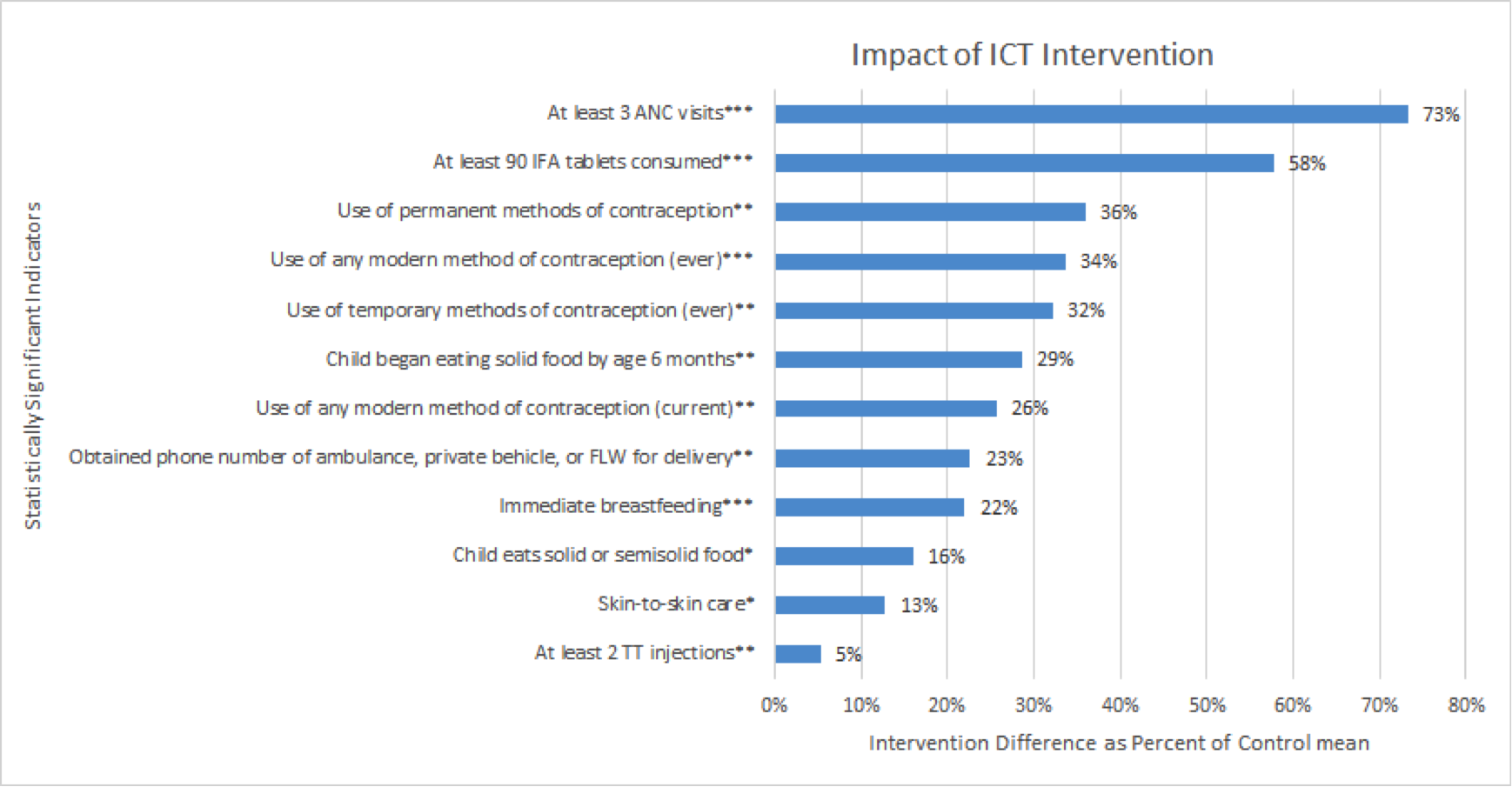
| 2015 | Grey literature | Client | India | Borkum 2015 Borkum, E., et al. Evaluation of the Information and Communication Technology (ICT) Continuum of Care Services (CCS) Intervention in Bihar. Mathematica Policy Research , 2015 “The intervention resulted in an 11 percentage point increase in FLW antenatal home visits during the third trimester (P = 0.04).” | View Borkum 2015 → |
| 2015 | Peer-reviewed | Feasibility | Many / Unspecific | Kumpel 2015 Kumpel E, Peletz R, Bonham M, Fay A, Cock-Esteb A, Khush R. When Are Mobile Phones Useful for Water Quality Data Collection? An Analysis of Data Flows and ICT Applications among Regulated Monitoring Institutions in Sub-Saharan Africa. Int J Environ Res Public Health. 2015;12(9):10846-10860. Published 2015 Sep 2. doi:10.3390/ijerph120910846 “mobile phone-based water quality data management applications will provide minimal benefits for Type A or B institutions, but prove worthwhile for Type C institutions in some contexts.” | View Kumpel 2015 → |
| 2015 | Peer-reviewed | Frontline worker | India | Chanani 2015 Chanani, S., Jayaraman, A., Wacksman, J. 101: Use of Mobile Technology for Improving Screening Accuracy of Acute Malnutrition in a Community-Based Management of Acute Malnutrition Program in Mumbai Informal Settlements. BMJ Open, vol. 5, doi:10.1136, 2015. “The mobile calculator significantly reduces an important component of human error in using the WHO tables to assess acute malnutrition at the community level.” | View Chanani 2015 → |
| 2015 | Peer-reviewed | Frontline worker | Many / Unspecific | Dayalu 2015 Dayalu, R., Wacksman, J., Chen, M., Loudon, M., Lesh, N. Adoption and Continued Use of Mobile Technology: An Analysis of CommCare Data. Procedia Engineering, 107: 247 – 254, 2015 “There were 634 workers who used CommCare for at least one year and were active for at least 10 months of that first year.” | View Dayalu 2015 → |
| 2015 | Peer-reviewed | Frontline worker | India | Kaphle 2015 Kaphle, S., Chaturvedi, S., Chaudhuri, I., Krishnan, R., Lesh, N. Adoption and Usage of mHealth Technology on Quality and Experience of Care Provided by Frontline Workers: Observations From Rural India. JMIR mHealth uHealth 3(2):e61, 2015 “The quality score for high users of CommCare was higher by 33.4% (P=.04), on average, compared to low users” | View Kaphle 2015 → |
| 2015 | Peer-reviewed | Frontline worker | India | Khalid 2015 Khalid, M., et al. Designing a Mobile Partograph for Real-Time Decision Support for Safer Deliveries in India. Proceedings of the 13th International Conference on Social Implications of Computers in Developing Countries, Negombo, Sri Lanka, 2015 “mLabour provides real-time decision support to healthcare providers in order to assess the course of labour and promote the appropriate interventions as necessary.” | View Khalid 2015 → |
| 2015 | Peer-reviewed | Frontline worker | Nigeria | McNabb 2015 McNabb, M., Chukwu, E., Ojo, O., Shekhar, N., Salami, H., Jega, F. Assessments of the quality of antenatal care services provided by health workers using a mobile phone decision support application in northern Nigeria: a pre/post-intervention study. Pathfinder International. 2014. “Overall, the quality score increased from 13.3 at baseline to 17.2 at endline (p<0.0001), out of a total possible score of 25” | View McNabb 2015 → |
| 2015 | Peer-reviewed | Frontline worker | Guinea | Sacks 2015 Sacks JA, Zehe E, Redick C, et al. Introduction of Mobile Health Tools to Support Ebola Surveillance and Contact Tracing in Guinea. Global Health: Science and Practice. 2015;3(4):646-659. doi:10.9745/GHSP-D-15-00207 “210 contact tracers in the 5 prefectures were actively using the mobile system, to collectively monitor 9,162 contacts.” | View Sacks 2015 → |
| 2015 | Peer-reviewed | Frontline worker | Many / Unspecific | Schweers 2015 Schweers, J. et al. mLabour: Design and Evaluation of a Mobile Partograph and Labor Ward Management Application. Humanitarian Technology: Science, Systems and Global Impact 2015, HumTech2015 “We then discuss the results of a preliminary study of the application's usage, which suggests that mLabour has promise as a tool to improve patient care.” | View Schweers 2015 → |
| 2015 | Peer-reviewed | Frontline worker | Guatemala | Segal 2015 Segal, J.B., Arevalo, J.B., Franke, M.F., Palazuelos, D. Reducing dosing errors and increasing clinical efficiency in Guatemala: first report of a novel mHealth medication dosing app in a developing country. BMJ Innovations, 0:1–6, doi:10.1136, 2015 “Among 366 prescriptions, dosages were 40% more likely to be correct when calculated using the app (relative risk: 1.39; 95% CI 1.16 to 1.68; p=0.0005).” | View Segal 2015 → |
| 2015 | Peer-reviewed | Frontline worker | Zambia | van Dam 2015 Van Dam J, Tadmor B, Spector J, et al. An open-access mobile compatible electronic patient register for rheumatic heart disease (“eRegister”) based on the World Heart Federation’s framework for patient registers. Cardiovascular Journal of Africa. 2015;26(6):227-233. doi:10.5830/CVJA-2015-058. “Preliminary lessons learned from early field testing of the eRegister in Zambia include demonstration that the tool was overall easy to use, and that local programme staff were able to be trained to use the eRegister in a relatively short time and without specific prior technical knowledge or experience.” | View van Dam 2015 → |
| 2015 | Grey literature | Frontline worker | Malawi | Kukla 2015 Kukla, Matt, Pamela Riley, and Sarah Dominis 2015. Evaluating the Cost-Effectiveness of a Mobile Decision Support Tool in Malawi. Bethesda, MD: Health Finance and Governance Project, Abt Associates Inc. “the mobile tool costs an additional $10.43 per annum for an HSA to improve his/her diagnostic and treatment accuracy by 1 percent.” | View Kukla 2015 → |
| 2014 | Peer-reviewed | Feasibility | Ghana | Amoah 2014 Amoah, B., Arthur Anto, E., Crimi, A. Phone-based Prenatal Care for Communities and Remote Ultrasound Imaging. Mobile and Information Technologies in Medicine. November 20-21, 2014 “The health workers followed 212 new pregnancy, sending more than 400 messages, cumbersome circumstances such as ectopic and breech delivery have been detected and addressed properly, thanks to the early detection performed using the portable ultrasound machine.” | View Amoah 2014 → |
| 2014 | Peer-reviewed | Feasibility | India | Bhavsar 2014 Bhavsar, M., Grijalva, K. From paper to Mobile: Design Considerations for Field Level Worker Programs. Mobile Communication For Development Conference. April 2014. Dakar, Senegal “Efficiencies gained from the mobile tool go beyond the frontline users and can reach the supervisory and program management levels, in retrospect, achieving systems-level improvements as well.” | View Bhavsar 2014 → |
| 2014 | Peer-reviewed | Frontline worker | South Africa | Surka 2014 Surka S, Edirippulige S, Steyn K, Gaziano T, Puoane T, Levitt N. Evaluating the use of mobile phone technology to enhance cardiovascular disease screening by community health workers. Int J Med Inform.2014;83(9):648–654. doi: 10.1016/j.ijmedinf.2014.06.008 “Incorrect calculations (4.3% of average systolic BP measurements, 10.4% of BMI and 3.8% of CVD risk score) were found when using the paper-based chart tool while all the mobile phone calculations were correct.” | View Surka 2014 → |
| 2014 | Peer-reviewed | Frontline worker | USA | Davidyock 2014 Todd A. Davidyock, Denis Rybin, Vikram S. Kumar, Pushwaz Virk, Davis Tang, Jeremey Wacksman, Gheorghe Doros, Anne Fuhlbrigge, George T. O’Connor. “Validation of ScreenFlow – A COPD Population Screening Instrument Using a Combination of a Questionnaire and Peak Expiratory Measurement.” Respiratory and Critical Care Medicine. 2014 “The ScreenFlow screening instrument created from the FHS data had good discriminatory ability for subjects with moderate-or-worse COPD in an urban, demographically mixed population.” | View Davidyock 2014 → |
| 2014 | Peer-reviewed | Frontline worker | Zimbabwe | Dell 2014 Dell, N., Francis, I., Sheppard, H. and Borriello, G. 2014. Field Evaluation of a Camera-Based Mobile Health System in Low-Resource Settings. International Conference on Human-Computer Interaction with Mobile Devices and Services “Prove that our systems can be effectively integrated into existing information ecosystems in low-resource settings and demonstrate that they are usable and appropriate under the constraints experienced at all levels of the information hierarchy.” | View Dell 2014 → |
| 2014 | Peer-reviewed | Frontline worker | Guatemala | Kanter 2014 Kanter, R., Alvey, J., & Fuentes, D. (2014). A Novel Mobile Phone Application to Assess Nutrition Environment Measures in Low- and Middle-Income Countries. Food and Nutrition Bulletin, 35(3), 296–300. https://doi.org/10.1177/156482651403500302 “The NEMS-S mobile app provides for more rapid data collection, with equivalent reliability and validity to the NEMS-S paper version.” | View Kanter 2014 → |
| 2014 | Peer-reviewed | Frontline worker | India | Mohamed 2014 Mohamed, N., Lesh, N., Conte, F., & Findlater L. Using ICT4CHW To Influence Decision Makers. Mobile Communication For Development Conference. April 2014. Dakar, Senegal. “This gives a pathway to engage key decision makers and ultimately, allow beneficiaries to access care.” | View Mohamed 2014 → |
| 2014 | Peer-reviewed | Frontline worker | Zambia | Schuttner 2013 Schuttner Linnaea, Sindano Ntazana, Theis Mathew, Zue Cory, Joseph Jessica, Chilengi Roma, Chi Benjamin H., Stringer Jeffrey S.A., and Chintu Namwinga. A Mobile Phone-Based, Community Health Worker Program for Referral, Follow-Up, and Service Outreach in Rural Zambia: Outcomes and Overview. Telemedicine and e-Health. August 2014, 20(8): 721-728. doi:10.1089/tmj.2013.0240 “CHWs performed one or more follow-ups on 74% (n=871) of active requests and obtained outcomes on 63% (n=741).” | View Schuttner 2013 → |
| 2014 | Grey literature | Frontline worker | Mozambique | Nascimento 2014 Nascimento, N., Cannon, M., Perales, N., Chariyeva, Z. Assessment of an mHealth initiative to improve patient retention. USAID, PEPFAR, Measure Evaluation. August 2014 “This report provides findings from a Mozambique pilot using mobile telephones to follow up on patients who have defaulted on their ART or have missed appointments or lab test dates.” | View Nascimento 2014 → |
| 2013 | Grey literature | Client | Afghanistan | World Vision 2013 Mobile Technology Strengthens Behavior Change Communication and Referrals by Community Health Workers for Maternal, Newborn, and Child Health in Rural Afghanistan. Operations Research Brief. USAID and World Vision. “In addition, mothers in the intervention group were significantly more likely than mothers in the comparison group to have had a CHW coordinate referral to a facility (17% vs. 5%).” | View World Vision 2013 → |
| 2013 | Peer-reviewed | Frontline worker | Vietnam, Cambodia, Mozambique | Ball 2013 Ball, M., Rahman, Z., Champanis, M., Rivett, U., Khush, R. Mobile Data Tools for Improving Information Flow in WASH: Lessons from Three Field Pilots. 2013. IRC Symposium 2013: Monitoring Sustainable WASH Service Delivery. Addis Ababa, Ethiopia “The use of the application improved the efficiency of information flows in all three settings, and increased data availability at upper administrative levels in Mozambique.” | View Ball 2013 → |
| 2013 | Peer-reviewed | Frontline worker | South Africa | Chaiyachati 2013 Chaiyachati KH, Loveday M, Lorenz S, Lesh N, Larkan L-M, et al. (2013) A Pilot Study of an mHealth Application for Healthcare Workers: Poor Uptake Despite High Reported Acceptability at a Rural South African Community-Based MDR-TB Treatment Program. PLoS ONE 8(5): e64662 “Mobile HCWs submitted nine of 33 (27%) expected adverse events forms, conflicting with qualitative results in which mobile HCWs stated that Mobilize improved adverse events communication.” | View Chaiyachati 2013 → |
| 2013 | Peer-reviewed | Frontline worker | Mexico,
Guatemala | Palazuelos 2013 Palazuelos D., Diallo A., Palazuelos L., Carlile N., Payne J., & Franke M. User Perception of an mHealth Medicine Dosing Tool for Community Health Workers. JMIR MHealth and UHealth. 2013; 1(1):e2 “93% (13/14) rated the phone as being easy or very easy to use, and 56% (5/9) who used the paper-based tool rated it as easy or very easy.” | View Palazuelos 2013 → |
| 2013 | Peer-reviewed | Frontline worker | India | Schwartz 2013 Schwartz, A., Bhavsar, M., Cutrell, E., Donner, J., Densmore, M. Balancing burden and benefit: non-prescribed use of employer-issued mobiles devices. Proceedings of the Sixth International Conference on Information and Communication Technologies and Development. 2013. DOI: 10.1145/2517899.2517911 “This work maps these rules against actual instrumental (work-related, non-prescribed) and non-instrumental (personal) device use, and enforcement of these rules, in eight projects using a popular mobile-based job aid, CommCare.” | View Schwartz 2013 → |
| 2012 | Peer-reviewed | Data | Tanzania | Birnbaum 2012 Birnbaum B.E., DeRenzi B., Flaxman A.D., & Lesh N. Automated quality control for mobile data collection. ACM DEV, 1-1, 2012 “We demonstrate the feasibility of tools for automated data quality control by showing that the algorithms detect the fake data in the labeled set with a high sensitivity and specificity, and that they detect compelling anomalies in the unlabeled sets.” | View Birnbaum 2012 → |
| 2012 | Peer-reviewed | Feasibility | India | Treatman 2012a Treatman D., Bhavsar M., Kumar V., & Lesh N. Mobile phones for community health workers of Bihar empower adolescent girls. WHO South-East Asia Journal of Public Health, 1(2), 224-226. 2012 “Sangeeta had recently finished a three-day training on using a new mobile phone application called CommCare as a job-aid tool for counselling adolescent girls and women on menstrual hygiene, sexually transmitted diseases, and family planning methods.” | View Treatman 2012a → |
| 2012 | Peer-reviewed | Frontline worker | Tanzania | DeRenzi 2012 DeRenzi, B. et al. Improving community health worker performance through automated SMS. The Fifth International Conference on Information and Communication Technologies and Development, 25-34, 2012 “In further studies, researchers found the comparative effect of adding a phone call from supervisors to alert midwives about missed and late visits was associated with an 86% reduction in the number of days that CHWs were overdue in visiting their clients.” | View DeRenzi 2012 → |
| 2012 | Peer-reviewed | Frontline worker | India | Medhi, 2012 Medhi I., Jain M., Tewari A., Bhavsar M., Matheke-Fischer M., & Cutrell E. Combating rural child malnutrition through inexpensive mobile phones. Nordic Conference on Human-Computer Interaction, 2012 “Through a three-month unsupervised field trial with ten rural health workers we report data management gains in terms of data quality, completeness and timeliness for 836 recorded patient cases, and demonstrate strong preference of the system by health workers.” | View Medhi, 2012 → |
| 2012 | Peer-reviewed | Frontline worker | India | Treatman 2012b Treatman D., Lesh N. Strengthening Community Health Systems with Localized Multimedia. Mobile for Development. Mobiles for Development, 2012 “We find that multimedia increases client engagement as well as CHW credibility and suggest identifying an engaging speaker and determining optimal audio message length as potential strategies for creating effective multimedia.” | View Treatman 2012b → |
| 2012 | Grey literature | Frontline worker | India | Kumar 2012 Kumar, A. and Bora, G. Msakhi: Putting Technology Into the Hands of Community Health Workers. In: 13th World Congress on Public Health; April 26, 2012; Addis Ababa, Ethiopia. “Qualitative data also indicated that after using the tool, the AHSA were more confident in their abilities, felt they were seen as more credible among their clients, and offered better counseling during home visits.” | View Kumar 2012 → |
| 2011 | Peer-reviewed | Feasibility | Many / Unspecific | DeRenzi 2011a DeRenzi B., Sims C., Jackson J., Borriello G., & Lesh N. A framework for case-based community health information systems. Global Humanitarian Conference, 2011 “This paper presents the CommCare framework for representing case-management tools for CHWs.” | View DeRenzi 2011a → |
| 2011 | Peer-reviewed | Feasibility | Many / Unspecific | DeRenzi 2011b DeRenzi B., Borriello G., Jackson J., Kumar V.S., Parikh T.S., Virk P., & Lesh N. Mobile phone tools for field-based health care workers in low-income countries. The Mount Sinai Journal of Medicine, 78(3), 406-418, 2011 “In this article we highlight 6 key functions that health systems currently perform where mobile tools can provide the most benefit.” | View DeRenzi 2011b → |
| 2010 | Peer-reviewed | Feasibility | Sierra Leone | Braa 2010 Braa J., Kanter A.S., Lesh N., Crichton R., Jolliffe B., Saebø J., Kossi E., & Seebregts C.J.,. Comprehensive yet scalable health information systems for low resource settings: a collaborative effort in Sierra Leone. AMIA Annu Symp Proc, 2010: 372-376, 2010 “We present the case of Sierra Leone and use this case to motivate and illustrate an architecture that allows us to provide services at each level of the health system (national, regional, facility and community) and provide different configurations of the tools as appropriate for the individual area.” | View Braa 2010 → |
| 2010 | Peer-reviewed | Feasibility | Tanzania | Mangilima 2010 Mangilima J., DeRenzi B., Lyons J., Mrema B., Ollis S., Schaefer W., Sims C., & Lesh N. CommCare: a phone-based tool for home based care in Tanzania. Second International Conference on Mobiles for Development, Kampala, Uganda, 2010 “This paper reports on CommCare a phone based tool designed to support community health workers in their work providing home-based care and social support to HIV+ and other chronically ill patients within Pathfinder International's Home based Care program.” | · |
| 2010 | Peer-reviewed | Feasibility | Many / Unspecific | Routen 2010 Routen, T. Silas, L.F., Mitchell, M., Van Esch, J., Lesh, N., Lyons, J. and Badiani, R. Using Mobile Technology to Support Family Planning Counseling in the Community – Case Study. Proceedings of the 3rd International Conference on ICT for Africa, 2010 “We adapted the Population Council's Balanced Counseling Strategy for local conditions and for community health workers and developed a mobile phone application incorporating the resulting algorithm.” | View Routen 2010 → |
| 2009 | Peer-reviewed | Feasibility | Tanzania | Bogan 2009 Bogan M., van Esch J., Mhila G., DeRenzi B., Lesh N., & Mitchell M. Improving standards of care with mobile applications in Tanzania. W3C Workshop in Africa to Explore the Role of Mobile Technologies for Development, Maputo, Mozambique. 2009 “While the formal evaluation of the program is still in progress, initial findings show that the phone-based system is generally viewed positively by the users and by the clients as more discreet and better for privacy than the paper-based system.” | View Bogan 2009 → |
| 2009 | Peer-reviewed | Feasibility | Tanzania | Mhila 2009 Mhila G., DeRenzi B., Mushi C., Wakabi T., Steele M., Roos D., Jackson J., Dhadialla P., Sims C., & Lesh N. Using mobile applications for community-based social support for chronic patients. HELINA, 2009 “In this paper, we present a phone-based application called CommCare which supports community health workers (CHWs) as they provide home-based care and social support to HIV+ and other chronic patients.” | View Mhila 2009 → |