In this post
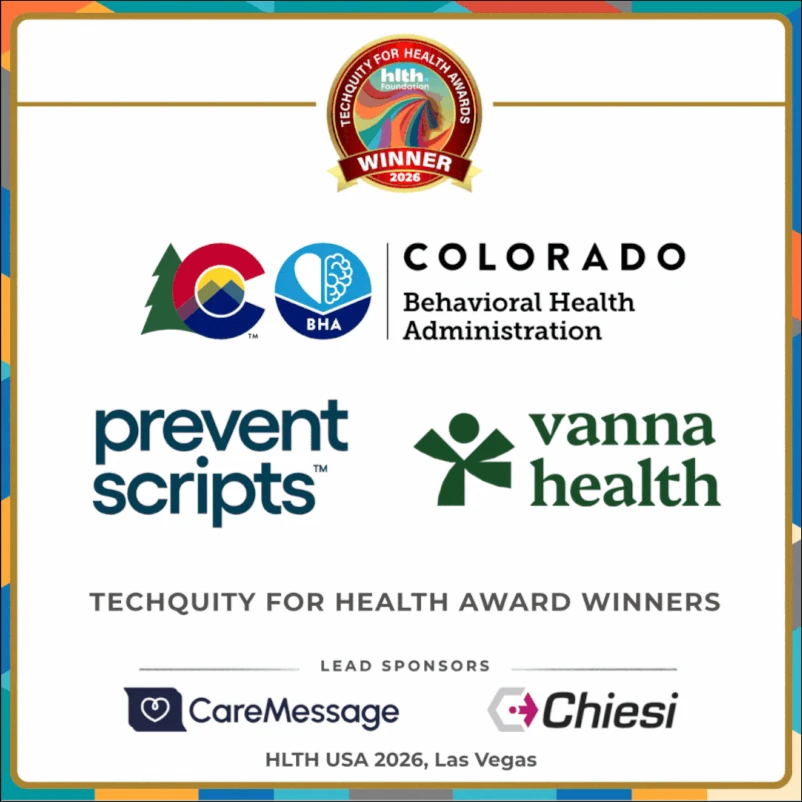
The MAT Central Registry, developed by Colorado’s Behavioral Health Administration (BHA) in partnership with Dimagi and the Colorado Digital Service, has been recognized as a winner of the 2026 Techquity for Health Case Study Awards. The award celebrates the initiative’s work to reduce administrative barriers to opioid use disorder treatment across Colorado.
Presented by the HLTH Foundation, the awards recognize projects using technology and data to address health disparities. Selected from more than 100 submissions, BHA was one of three winners announced at HLTH USA in Las Vegas on November 15.
Removing barriers when people are ready for care
For individuals seeking treatment for opioid use disorder, delays in the admissions process can mean additional waiting at a time when they are ready to begin care. These delays can be especially challenging for people already navigating transportation barriers, unstable housing, or limited access to treatment in rural communities.
Previously, opioid treatment programs in Colorado relied on state employees to verify that an individual wasn’t already enrolled in treatment elsewhere. State staff searched admission records and, when necessary, contacted other providers to confirm enrollment status. Depending on the availability of information and provider contacts, this process could take hours or even days.
BHA set out to streamline this process.
Working with the Colorado Digital Service and Dimagi, BHA developed a modernized Medication-Assisted Treatment (MAT) Central Registry using the CommCare platform. The Registry allows clinic staff to independently verify enrollment status and complete admissions within a single workflow, reducing a process that once took hours or days to approximately two minutes.
Today, 97% of admissions no longer require direct state intervention, reducing administrative burden for providers and state staff while removing a significant source of delay for people seeking treatment.
Faster admissions and better statewide visibility
Since its launch, the Central Registry has supported more than 36,000 admissions into opioid treatment programs across Colorado. Today, more than 10,000 Coloradans are enrolled in opioid treatment, the highest number in state history.
Beyond streamlining admissions, the Registry gives BHA a clearer statewide picture of treatment participation. The state can now track how many people are receiving treatment at any given time and how long they remain in care.
The Registry also helps BHA identify geographic gaps in access to treatment. These insights have helped guide Colorado’s expansion from 25 to 54 opioid treatment sites, more than doubling the number of locations where people can receive care.
The project demonstrates an important lesson for public health technology: improving access to care doesn’t always require creating a new treatment program or replacing an entire technology system. Sometimes, removing an administrative barrier with a focused, easy-to-use tool can make a meaningful difference for people seeking treatment.
“The Central Registry is vital to patient safety in Colorado OTP care, streamlining the process from days to minutes.”
Muhammad Imran, Controlled Substance Licensing Manager, Colorado BHA
Congratulations to BHA and its Technology and Data (TaDa) team on this well-deserved award! We’re proud to have supported BHA’s vision and to see this important work recognized.
Learn more about the 2026 Techquity for Health Award winners.
Coordinating care across a system of your own?
Talk to our team about how CommCare can centralize fragmented workflows and data to streamline care delivery.
Explore our US services